

• About Alachua County Today
  • Advertise
  • News
  • Community Calendar
  • Public Notices
Alachua County Today Alachua County Today

Boukari Law, P.A.

 PLACE YOUR LEGAL NOTICES HERE

17
Wed, Dec
627 New Articles
  • Home
  • Advertise-Subscribe-About Us
    • About ACT News
    • Advertise
    • Subscribe
  • Calendar
    • Calendar
    • Gov't Meetings
  • News
    • Local
    • Obits
    • Sports
  • Public Notices

Swamp Bots Coming to A Town Near You
Details
RAY CARSON
Local
18 September 2020
  •  Print 
  • Email

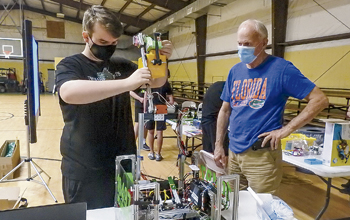
ALACHUA ‒ The Swamp Bots of Alachua are working to make science more appealing to students. Composed of students from several Alachua County high schools, they recently held one of several upcoming exhibitions to engage kids in kindergarten through high school in exciting, mentor-based, research and robotics programs and is open to all skill levels. The goal is to help them become science and technology leaders, as well as well-rounded contributors to society. The initial exhibition by the Swamp Bots took place at the City of Alachua’s Hal Brady Recreation Center on Sept. 3. Kids faced a course laid out on a plywood board and were given Legos to build robots they could program to navigate the course

The Swamp Bots are part of FIRST (For Inspiration and Recognition of Science and Technology), which is an organization founded to build student interest in STEM—science, technology, engineering, and mathematics. These fields will play an important part in the jobs of the future. There are groups of FIRST members throughout the world with over 90,000 members.

The organization was founded in 1989 by inventor Dean Kamen, who is best known for inventing the Segway PT, an electric, self-balancing human transporter with a computer-controlled gyroscopic stabilization and control system. Kamen was already a successful inventor when he produced the Segway.

Kamen created FIRST to foster the love of science in a younger generation. His vision was "To transform our culture by creating a world where science and technology are celebrated and where young people dream of becoming science and technology leaders”. But FIRST is more than robots. The Robots are a vehicle for students to learn important life skills. “Kids often come in not knowing what to expect from the program or themselves,” said Kamen. “They leave with a vision, with confidence, and a sense they can create their own future.”

There are several levels to the FIRST program based on age. FIRST LEGO League introduces children ages 4-16 o science through fun, exciting hands-on learning. The participants gain real-world problem-solving experiences through a guided, global robotics program using Legos to build robots that can be programmed to complete a course.

FIRST Tech Challenge teams (up to 15 team members, grades 7-12) are challenged to design, build, program, and operate robots to compete in a head-to-head challenge in an alliance format. Guided by adult coaches and mentors, the students develop STEM skills and practice engineering principles, while also realizing the value of hard work, innovation, and working as a team. The robot kit they build is reusable from year to year and can be coded using different levels of Java-based programming.

Teams design the robots, raise funds to build it, design and market their team brand, and do community outreach to earn specific awards. Participants are eligible to apply for part of $80 million in college scholarships. Each season concludes with regional championship events

For high school students and their mentors, there is the First Robotics Competition. Under strict rules and limited time and resources, the teams of high school students are challenged to build industrial-size robots to play a difficult field game in alliance with other teams, while also fundraising to meet their goals, designing a team “brand,” and gives the teams an opportunity to work and create together.

“The competition is more than building robots and competing,” said Ben Sanders, mentor of the Alachua Swamp Bots group. “They also have to explain to the judges how they built it to show the analytical thought process. While the core value is problem solving, they also have to show the judges that they worked as a team with input from everyone. The judges want to see that they thought it out before acting,” Sanders said.

“In the competition, cooperation is important, not just within a team but against competitors as well,” said Sanders. “If a team or person is rude or arrogant to others or doesn't work as a team, the judges will scratch them from the event. While it is meant to be a fun challenge, it is also meant to teach social skills, cooperation and be a contributing member in society,” Sanders said.

The Swamp Bots group started in Sanders’ living room in 2012 and his son is one of the members. Sanders, a mechanical engineer, works in Progress Park and considers the Swamp Bots as his weekend hobby with his kids. But the Swamp Bots don't just compete, they also demonstrate the excitement of designing and creating, working together and gaining confidence in abilities to younger students. That's the group is holding free exhibits where any student between four and 18 can attend, build and program a Lego robot to work through the outlined course.

The Alachua Swamp Bots received a grant from the Children's Trust of Alachua to help start groups of middle school students. So far, they have helped initiate groups in High Springs, Alachua and Turkey Creek, all mentored by an adult. Another group is currently forming in Waldo.

More information on the FIRST program can be found at https://www.firstinspires.org/ . For information on local activities and groups, contact Ben Sanders at sanders32615@gmail.com.

“We want to make science exciting and show kids the achievements they can make both as individuals and as a team and help shape their future,” Sanders said.

#     #     #

Email rcarson@

alachuatoday.com

Add a comment
Haven Hospice and Queen of Peace Team Up to Provide PPE

Details
Administrator
Local
18 September 2020
  •  Print 
  • Email

GAINESVILLE ‒ Healthcare facilities continue to face personal protective equipment (PPE) shortages amid the COVID-19 pandemic, Haven included.

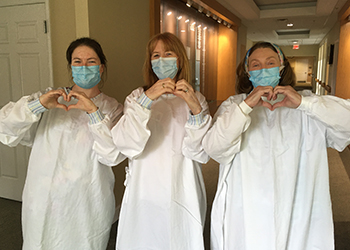
Gainesville’s Queen of Peace Catholic Church learned of a gown shortage and donated a large quantity of used sheets through a recent outreach event. The sheets would later be converted into gowns for Haven’s clinical staff and visiting family members to wear.

Greg Hollingshead, who oversees outreach ministry at Queen of Peace, said, “When the COVID pandemic became acute in March, we got in contact with our ministry partners and asked, ‘How can we help?’ This question turned into an expansion of our monthly food program. But in May and June, in talking to other organizations, we realized they had non-food missions we may be able to help with. To respond to specific needs, we made a wish list. We learned that Haven was experiencing difficulty getting gowns so we put sheets on the wish lists for Haven’s volunteer seamstresses.”

Haven’s volunteers are not currently able to visit patients due to COVID-19, but have been searching for ways to continue serving. When Queen of Peace donated sheets, volunteers in each of Haven’s service areas offered to sew the sheets into gowns.

The volunteers used a CDC-approved gown pattern to convert the sheets into safe, usable PPE. “I’m a retired nurse so I know how important protective equipment is. I didn’t know clinical staff at Haven were still having difficulty getting them,” said volunteer Joan MacLeod. “I’ve been sewing since I was a little girl and have a nice machine. I’ve got it down to where I can make one gown in three hours. I just finished the eighteenth gown. As long as Haven needs them, I’ll keep making them and am happy to do so.”

MacLeod, who is a long-time Haven Advance Care Planning volunteer, said that she is sewing gowns for the Gainesville area and that seamstresses in Haven’s other service areas have also volunteered to continually make gowns.

Haven proudly continues to serve patients, including those who are COVID-19-positive, across the state. Various challenges have arisen as a result of the pandemic and Haven is thankful for those who have helped creatively address these obstacles.

“Haven is grateful that Queen of Peace quickly and graciously donated sheets to be made into gowns in a time of need,” said Haven Director of Clinical Operations Brigid Doherty. “In a time where personal protective equipment is hard to come by, the community and our volunteers have stepped up to serve our clinical staff, as well as our patients and families, in unique ways.”

In regard to continued partnership, Queen of Peace’s outreach ministry leader Hollingshead said, “We were told that we far exceeded Haven’s expectations. As far as sheets are concerned, we had people clean out their entire linen closet and donate. We’re happy to do it. Hopefully this is the beginning of a long-term relationship between us and Haven.”

#     #     #

Email editor@

alachuatoday.com

Add a comment

Facelift in Store for Poe Springs - Popular Park Closing Sept. 14

Details
RAY CARSON
Local
10 September 2020
  •  Print 
  • Email

HIGH SPRINGS ‒ Alachua County’s popular Poe Springs Park will soon be closing for construction and improvements. The closure will start Tuesday, Sept. 14, except for the boat ramp. It is anticipated that construction will stretch until January 2021. There will still be a $5 vehicle entry fee for the use of the boat ramp.

The 202-acre park on the Santa Fe River is near High Springs on County Road 340. Poe Springs is rated as second-magnitude in terms of the water that flows out of it — about 45 million gallons a day and is the largest spring in Alachua County.

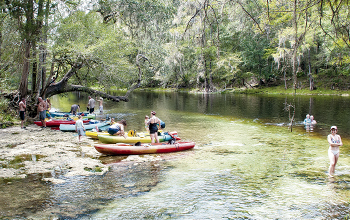
A popular weekend recreation area, the property includes a playground, volleyball courts, sports fields and nature trails. It also includes pavilions and picnic shelters with bar-b-que grills. There is also a lodge building for event rentals, such as parties, family gatherings and small weddings. There is a full-service kitchen in the building which is included in the rental fee. Restrooms are on-site, and there is additional picnic table seating under the attached pavilion. There are loop trails throughout the park for hiking, and a boardwalk that traverses the cypress swamp that leads visitors to the springs. A boat launch and dock afford watercraft access to the river for boating kayaking, tubing and fishing.

The spring itself has a large area for swimming, relaxing or snorkeling in the year round 72-degree water. The crystal-clear spring water feeds directly into the Santa Fe River.

The park has a rich history spanning nearly 70 years of inviting people to enjoy nature and water-based recreation. In the mid-1940s Poe Springs was a commercial recreation site with bathhouses, refreshment stand, and picnic facility, but it fell into disrepair in later years and most of the buildings were taken down.

Poe was privately owned until 1985 when the initial 75 acres was purchased with a federal grant from the land and water conservation fund. Additional acreage was acquired by the Suwanee River Water management District (SRWMD) and additional grant funds in the 1980s. In 1987 the county obtained a permit to dredge the spring boil from a depth of 12 feet to 25 feet. Four years later, in 1991, Alachua County finished construction and opened the park to the public.

Alachua County shut the park again in December 2011 for a construction project that included a new retaining wall and steps in the spring-fed swimming area, new landscaping and new roofs and air-conditioning units on the buildings and pavilions. It reopened again on July 4, 2013 with no admission charge four days a week Thursday through Sunday.

Although Alachua County owned the park, it was a barebones operation and the county and High Springs made arrangements for the city to run the park.

It closed again in 2017 due to damage from Hurricane Irma and opened again in May 2018 after repairs were made but on a shorter weekend only schedule of Friday to Sunday, but was still free to visit.

Then came the COVID-19 pandemic and the park closed again under state quarantine in March 2020 only to open again three months later with a $5 per car fee to help maintain the park and pay employees.

But more repairs and upgrades are still needed. The boardwalk, which winds through a wetland to the spring, was severely damaged by Hurricane Irma in September 2017. It was repaired enough to make it usable, but it will now be widened in compliance with the Americans with Disabilities Act, heightened and lengthened to the spring.

During the closure, the work will include widening and lengthening the boardwalk to the spring, replacing the canoe/kayak launch and replacing the restrooms. Contractors will also be required to install silt fencing to protect water quality and the process will be monitored by the county.

An infusion of cash from the federal government and a local tax will pay for upgrades at the park. Funding is provided jointly through Federal Emergency Management Agency (FEMA) and Alachua County’s Wild Spaces Public Places tax. FEMA will kick in $280,665 while the county’s share is $284,152.

The expected reopening date is mid-January 2021.

#     #     #

Email rcarson@

alachuatoday.com

Add a comment
Back to School Takes on New Meaning, First day Aug. 31

Details
RAY CARSON
Local
10 September 2020
  •  Print 
  • Email

ALACHUA COUNTY ‒ On Monday Aug. 31, schools in Alachua County reopened for in-person classes for the first time since mid-March. Due to COVID-19, the last semester of the 2019-20 school year was taught virtually online as educators scrambled to rethink teaching delivery.

The Class of 2020 graduated in the spring with limited graduation ceremonies and proms and many of the other activities traditionally associated with the transition from school to adulthood. For students with more years to go, there is an uncertainty of whether there will be a return to traditional in class education.

This year, back to school has taken on new meaning as the School Board of Alachua County (SBAC) is offering several options that have been approved by the Florida Department of Education (FLDOE). In addition to brick and mortar teaching, the SBAC offers the new Alachua Digital Academy.

Through the Academy, students will receive live lessons provided by teachers from their school of enrollment. The model allows them to interact with their classmates online, and their daily schedule mirrors the regular school schedule. Students are provided with devices if they don’t have them, and the district will work with families to obtain Internet access. Digital Academy students also have access to free meals and other programs and services.

A third instructional option for local families is the Alachua eSchool, which allows students to learn material and complete coursework on their own schedule and pace without live lessons. The eSchool has been in existence for eight years and during the last school year served about 3,000 full and part-time students.

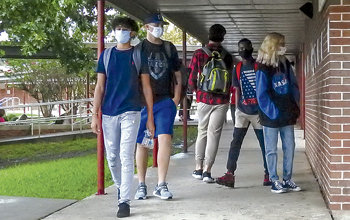
In July, the SBAC asked parents to vote on which method they preferred. Of those who responded, about 41 percent selected the traditional in-person model, 41 percent selected the Digital Academy and 18 percent chose the eSchool. The SBAC is offering all three options and is working to balance safety and health concerns while maintaining effective in-class teaching for bricks and mortar learning. This ‘traditional’ model includes significant health and safety protocols, including but not limited to mandatory masks, intensive cleaning/sanitizing, and strategies to promote as much social distancing as possible.

The district has also been working closely with the Alachua County Health Department and experts from the University of Florida on COVID-related safety protocols, including the steps the district will take if a student or staff member tests positive.

There have been concerns about whether schools could reopen safely and not become a mega breeding ground for COVID infections. Some teachers and staff felt they would be risking their own safety and that of their students if the reopening was done to soon. Teachers in Florida, along with the Florida Education Association (FEA), sued the State to block an emergency order requiring schools to open with in-person instruction. They say, with the high number of coronavirus cases in Florida, the order violates a provision in the Florida Constitution requiring the state to ensure schools are operated safely.

It is especially concerning for the teachers as they deal with multiple classes daily, exposing them to more than just one classroom. In some places, including Alachua County, teachers have organized protests, stating their disagreement and concern about reopening. Initially a judge ruled in the FEA's favor, but then the State asked to move the trial to Tallahassee, which effectively delayed any action to limit the school year opening until after the school's opening date and the mandated in-person classes.

Some other states that have reopened have seen a surge in cases. In Canton, Georgia, the Cherokee County School District reopened on Aug. 3. Within two weeks nearly 1,200 students and staff members in the district had already been ordered to quarantine. Two high schools in that county closed until at least Aug. 31. Several colleges, including the University of North Carolina, are offering only online learning.

For many families, remote learning from home is difficult. Parents with younger students have had to miss work or even lose jobs due to the need to homeschool and babysit children. Some low-income families have trouble gaining access to online learning despite efforts by the school system to provide computers and internet access.

Another factor affecting low-income families is the meals program. For some students the lunch they get at school may be their only or biggest meal. Throughout the end of the last school year and all through the summer, the SBAC made a monumental effort to provide meals to every student. Since the end of March, the district has distributed more than 2.3 million meals to students across Alachua County.

For many older students the isolation and lack of social contact is a major factor in wanting to return to school. But risks remain and only time will tell both if reopening was safe and effective and whether the state and federal governments are providing accurate information for the schools and parents to make an informed choice on which method to choose.

The SBAC has tried to make the school as safe as possible with strict regulations on mandatory masks for students and staff as well maintaining social distancing, temperature checks and removing anyone who shows symptoms.

At Santa Fe High School, 71 percent of the students have chosen the brick and mortar option, higher than the average. Principal Dr. Timothy Wright says they have set up traffic flow patterns so all students move in one direction with northbound students using the main front walkway and southbound students using the back walkway.

“Each teacher has a temperature gauge to test students as they enter the classroom and chairs are distanced six feet apart.” Said Wright. “For lunch time, we are serving boxed lunches and have put markers on seats to maintain the social distance as well as set up tables outside. In the more narrow interior walkways, we have signs directing students to walk to their right to keep lines from intermingling from different directions.”

At Irby Elementary, Principal Tanya Floyd said they have about 50 percent of their students returning for in-class learning. While the rules for social distancing and masks are the same as other schools, Floyd said that they are also trying to make it less about regulations and more about learning to help calm the fears of the younger students. “We are trying to put more emphasis on colorful signs and making mask wearing part of the education process rather than regulations.”

While the schools are trying to do as much as possible to safeguard staff and students, they are also emphasizing that parents also have a responsibility in the process. The SBAC website has a list of procedures parents should follow every day before sending their children to school.

Parents are asked to do a temperature check each morning and if it is 100.4 or above the student should not go to school. Other signs to look for are chills, new cough or shortness of breath, unusual fatigue, muscle or body aches, new onset of severe headaches, especially with a fever, new loss of sense of taste or smell, sore throat, non-allergy congestion or runny nose, diarrhea, vomiting or abdominal pain.

Students who have had significant exposure (within six feet for at least 15 minutes) with someone who has COVID-19 may return to school 14 days after their exposure as long as they have no fever or other symptoms or they have a documented negative test result on the ninth day after their exposure.

Students who have tested positive for COVID-19 may return to school when they have gone 24 hours without a fever (and without the use of fever-reducing medicines), their symptoms have improved and it has been at least 10 days since the test was administered. More information can be found at the SBAC website at https://www.sbac.edu/

The SBAC believes the reopening can work as long as the schools, parents, health officials and the State government work together to maintain the necessary safeguards and provide accurate information. Whether the reopening will work or be a breeding ground for a surge of cases will only be determined by what happens within the next two weeks, which is the average time for an infected person to show symptoms.

#     #     #

Email rcarson@

alachuatoday.com

Add a comment
Watson Routs Darnell in Sheriff’s Race, County Commissioner Byerly Also Ousted

Details
Administrator
Local
26 August 2020
  •  Print 
  • Email

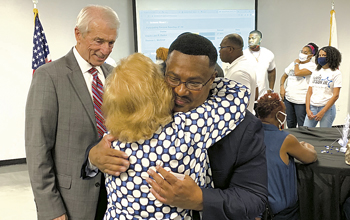
Clovis Watson, Jr. (right) receives a congratulatory hug from a supporter Tuesday evening following results from the race for sheriff in which Watson handily won over incumbent Sheriff Sadie Darnell.

ALACHUA COUNTY ‒ Clovis Watson, Jr. handily defeated incumbent Sadie Darnell to be Alachua County’s top law enforcement official. After first being elected Nov. 14, 2006, the longstanding Sheriff Darnell will lose her seat in the coming months as Watson formally takes over the role of Alachua County Sheriff at the beginning of 2020.

Watson picked up 23,110 votes, or 59.3 percent compared to Darnell’s 15,851 votes, or 40.7 percent of the votes according to the unofficial tally by the Alachua County Supervisor of Election.

Watson and Darnell were in a closed primary race, meaning only Democrats could cast ballots because Rob Brinkman jumped in the race as a write-in general election candidate. That means Watson will face off against Brinkman as a write-in candidate in the general election, although Watson’s election is nearly a foregone conclusion since Brinkman is not campaigning.

While only registered Democrats could cast ballots in Tuesday’s primary, according to campaign finance reports, Watson garnered a wide cross-section of support.

Watson currently serves in the Florida House of Representatives in House District 20. For several years, he led his hometown, the City of Alachua, as its city manager, and has an extensive background in law enforcement, having served for many years as the Deputy Police Chief in the City of Alachua.

Darnell was not the only incumbent to lose in the Aug. 18 primary. Longtime Alachua County District 1 Commissioner Mike Byerly with 34.2 percent lost to fellow-Democrat Mary Alford who picked up 65.8 percent of the vote tally.

Alachua County Commissioner for District 3, Robert “Hutch” Hutchinson, who chose not to seek re-election, will be replaced by Anna Prizzia (49.1 percent), who beat Kevin Thorpe (36.9 percent) and Jason Stanford (14 percent).

Alachua County Commissioner for District 5, Charles “Chuck” Chestnut, IV, faced no challenger in the Aug. 18 election and will retain his seat. As a result of Tuesday’s election, and for the first time, women will make a majority of the Alachua County Board of County Commissioners.

In an historic shakeup on the Alachua County School Board, Diyonne L. McGraw (52.4 percent) won the District 2 seat over Khanh-Lien R. Banko (47.6 percent). McGraw replaces Eileen F. Roy on the school board. Meanwhile, Leanetta McNealy (61percent) will retain her District 4 school board seat after defeating Sande Calkins (39 percent). With McGraw, McNealy, and Tina Certain (District 1), the School Board of Alachua County will consist of three African-American women for the first time in school board history.

In Newberry, incumbent Commissioner Monty Farnsworth was re-elected with 55.3 percent as compared to challenger Walt Boyer’s 44.7 percent of the votes cast in Tuesday’s election. Newberry voters did adopt some revisions to the City’s charter, but declined to increase the terms of service from two years to three years for the mayor and commissioners.

Hawthorne voters elected Patricia Bouie (72.1 percent) to Seat 4 over Wallace F. Russell (27.9 percent). In Archer, voters elected Joan White (61.8 percent) to Seat 1 over Bill Lewandowski (38.1 percent) and Fletcher Hope (62.3 percent) to Seat 3 over Mary Bennett (37.7 percent).

With Alachua County Property Appraiser Ed Crapo declining to seek re-election, Ayesha Solomon (48.8 percent) will take on the role after facing off against Matt Geiger (27 percent), Wendy Sapp (13 percent), Susan M. McQuillan (6.2 percent) and Kelly F. Suggs (5 percent).

Replacing Clovis Watson, Jr. as the Florida House District 20 representative will be Yvonne Hayes Hinson. Hinson, with 61.8 percent of the votes beat out Rodney Long, who had 38.2 percent of the votes cast. Long had served as an Alachua County Commissioner for a number of years in the 2000s, and as a Gainesville city commissioner beginning in 1988, but has been out of elected public office for years since leaving the county commission.

In the hotly-contested U.S. House of Representatives District 3 Republican primary race, Kat Cammack won with 25.2 percent of the ballots cast over Judson Sapp (20 percent), Gavin Rollins (15.3 percent), James St. George (14.1 percent), Todd Chase (9.5 percent), and five other candidates garnering a combined 15.9 percent of the votes. Cammack will face off in the Nov. 3 general election against Adam Christensen who won 34.5 percent of the votes cast in the U.S. House of Representatives District 3 Democrat primary race. Christensen beat out Philip Dodds (32.3 percent) and Tom Wells (33.2 percent). Given the voter makeup of House District District 3, and the history of Republican victories over the district, it is likely that Cammack will prevail in the Nov. 3 general election.

#     #     #

Email editor@

alachuatoday.com

Add a comment

More Articles ...

  1. Alachua Honors Longtime Veteran’s Advocate Butch Mullins
  2. Alachua Youth Advisory Council Receives Statewide Award
  3. San Felasco Parkway Open for Business, Shovel-Ready Sites Available For High-Tech Industry
  4. School Board Sets Options for School Year
Page 109 of 303
  • Start
  • Prev
  • 104
  • 105
  • 106
  • 107
  • 108
  • 109
  • 110
  • 111
  • 112
  • 113
  • Next
  • End
Alachua County Today Alachua County Today

Explore

  • About Alachua County Today
  • Advertise
  • News
  • Community Calendar
  • Public Notices