

• About Alachua County Today
  • Advertise
  • News
  • Community Calendar
  • Public Notices
Alachua County Today Alachua County Today

Boukari Law, P.A.

 PLACE YOUR LEGAL NOTICES HERE

17
Wed, Dec
627 New Articles
  • Home
  • Advertise-Subscribe-About Us
    • About ACT News
    • Advertise
    • Subscribe
  • Calendar
    • Calendar
    • Gov't Meetings
  • News
    • Local
    • Obits
    • Sports
  • Public Notices

Women Entrepreneurs Thank Front-Line Workers
Details
RAY CARSON
Local
21 May 2020
  •  Print 
  • Email

NEWBERRY – Many small businesses are built on a dream—people wanting to follow a passion and start a new business in their control and direction. The new digital age has allowed these small businesses to get exposure and gain clientele. Some of the more artistic businesses also depend on art shows, fairs and exhibits to increase their market. Now, any events that includes crowds are on hold for an undetermined time. Over 24 million jobs have disappeared in fewer than two months.

Deborah Salmi is a digital marketing professional by trade, but she started her own business designing and making hand-poured aromatherapy soy candles under the company name of Ritual Tree.

“For each candle sale, I give a portion of the sales proceeds to the Nature Conservancy to plant trees in degraded areas, restore wetlands, and plant new forests,” Salmi said. “After you use your candle, the pot can be repurposed for planting. The dust cover that came with your candle, is biodegradable seed-infused paper made by a local artist and you can wet the cover and plant it”

Newberry resident Mandy Wyrick makes handcrafted bath and spa products under the company name of Ginger Bomb Naturals. Each are made by hand with natural ingredients and a large variety of scents and natural ingredients.

Dee Mullin is also from Newberry and owns a plant and succulent nursery. Mullin has over 25 years of experience as a freelance floral designer and now concentrates on designs with succulents. She has a successful business doing event arrangements, art shows and festivals.

These three independent business women have something in common. Like so many others, all future business disappeared. Salmi was looking at all her inventory of candles meant to relax and remove stress that were simply gathering dust. She also knew that despite her loss of work, there were many people still working in often stressful but necessary positions who were putting their own health on the line to provide services for the general public. There has been recognition of heroic efforts and self-sacrifice by medical and first responders in this pandemic. But there are less visible jobs that may not be as dangerous or intense, but still put the worker at risk and are necessary to maintain.

Grocery store workers have important, “essential” jobs that put them on the front lines during the ongoing coronavirus pandemic. Their work is high-risk because they are in direct contact with potentially infected members of the public; oftentimes with little protective gear. There are reported increasing cases in the food and service industry. It’s a hard decision to go to work every day, never knowing if you may come in contact with an invisible enemy.

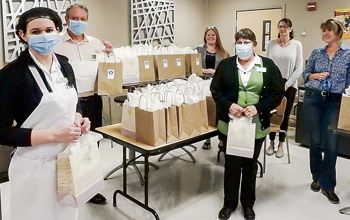
It was then that Salmi contacted Mullin and Wyrick with a concept. All three had a surplus of product that were meant for relaxation and beauty, so why not make gift packages to take to grocery stores and hospitals to thank the employees for their dedication. They called the project Scents, Suds and Succulents for Essential Workers.

The idea was to help these essential workers manage their stress, using surplus inventory from canceled craft shows and farmer’s markets and put together in gift bags. These beautiful handmade gifts are designed to ease stress and encourage relaxation and let these employees know that they are appreciated.

“Our own Scents, Suds & Succulents team member, Mandy, knows this first hand because her mother, Judy Kail, is a grocery store worker in Pennsylvania,” Salmi said.

On April 28, the women took three carts of gift bags to the Publix at Hunters Crossing to give to the employees, with a little over 100 self-care bags for their workers.

That first batch of gift bags came from their own supply of handmade products and plants. They hope to continue sharing the love, but with more than 2,700 local employees of Publix alone, not to mention the other food stores in town, it’s not economically possible for them alone.

They have set up a GoFundMe page under Scents, Suds, and Succulents for Essential Workers. The link to that page is https://bit.ly/2yWeKLi

All money donated will strictly go to materials for these gifts. They hope that other people will see the purpose and value in giving a small gift of appreciation to the people working in these troubled conditions., If enough can be raised the group wants to expand the gifts to hospital workers as well.

#     #     #

Email rcarson@

alachuatoday.com

Add a comment

Local Businesses Reeling from Shutdown

Details
RAY CARSON
News
25 April 2020
  •  Print 
  • Email

ALACHUA County – The COVID-19 virus continues to impact Florida. On April 14, the State Health Department confirmed there were 21,628 cases, an increase of 1,027 from the previous day, with an additional 111 deaths for a total of 585 deaths. The effect on the economy and businesses has been catastrophic. For many small businesses, staying closed for any length of time with no revenues could use up whatever capital and reserves the owners have and doom the business.

Southeast Florida has been the hardest hit, but there are 626 cases in North Central Florida, including 196 in Alachua County. Although increasing daily, one of the reasons that Alachua County has been able to slow the increase is because of the early “stay-at-home quarantine” requirements imposed by the county. These requirements that canceled all events over 10 people and required closing all non-essential businesses weeks before Florida Governor DeSantis made it mandatory throughout the state. These self-isolation techniques have been shown to slow the rate of transmission in other parts of the country.

Financial Assistance Available

The Federal government has passed a $2 trillion stimulus package that is unprecedented in its sheer scope and size, touching on every facet of American life with the goal of salvaging and ultimately reviving a battered economy.

The legislation will send direct payments of $1,200 to millions of Americans, including those earning up to $75,000, and an additional $500 per child. It would substantially expand jobless aid, providing an additional 13 weeks and a four-month enhancement of benefits, and would extend the payments for the first time to freelancers and gig workers.

While this will help Americans get by for a month, much more is needed for struggling businesses. The bill also offers $377 billion in federally guaranteed loans to small businesses and established a $500 billion government lending program for distressed companies reeling from the impact of the crisis.

Additionally, the U.S. Small Business Administration (SBA) is offering low-interest federal disaster loans for working capital to Florida small businesses suffering as a result of the Coronavirus (COVID-19). SBA acted under its own authority, as provided by the Coronavirus Preparedness and Response Supplemental Appropriations Act that was recently signed by the president to declare a disaster. Any state that is declared in a state of emergency or disaster area gets access to more federal funds for both business and medical operations.

Small businesses, private non-profit organizations of any size, and small agricultural operations may qualify for Economic Injury Disaster Loans of up to $2 million to help meet financial obligations and operating expenses to help overcome the temporary loss of revenue from the COVID-19 pandemic. The interest rate is 3.75 percent for small businesses and the SBA offers loans with long-term repayments up to a maximum of 30 years.

However, many smaller businesses also had to lay off staff, bringing the unemployment rate to record highs. Florida’s CONNECT unemployment site has been answering only two percent of the thousands of calls received, with wait times averaging more than six hours. Florida Small Business Emergency Bridge Loan Program is an additional program to support small businesses. The program, managed by the Florida Department of Economic Opportunity (DEO), provides short-term, interest-free loans to small businesses. On April 14, the DEO website states it is continuing to review applications that were received online or postmarked by Monday, April 13, 2020 and will continue to process loans for Florida businesses affected by the economic impacts of COVID-19 until available funds are expended.

A common problem is that all of these applications and receipt of funds take time, possibly months due to the numbers of people applying for assistance. For many small businesses, restaurants and bars, the current loss of income can be irreversible.

Local Business Scene

Locally, many businesses are reinventing the way they reach customers and make sales. Many have turned to internet sales and social media, giving the customers the option to shop online and order items for pick up or delivery.

Tina Lanza, who owns Lanza Gallery and Art supplies in High Springs, has turned to the internet and Facebook to make customers aware of her products and offers suggestion about what supplies work best with each art medium. Each item ordered is wiped down with antiseptic wipes and delivered to the customer curbside outside her store. Although it has been a struggle to transition from the traditional storefront sales, Lanza is seeing the business pick up. River Run, an olive oil store, is also using the internet, offering recipes and food/wine pairing suggestions for their various oils.

The High Springs Brewing company was a popular night spot with handmade craft beers, food trucks and entertainment until Alachua County closed all restaurants and nightclubs, as well as all live entertainment. The brewery was eligible to sell sealed packaged drinks for consumption off site, and they are open 4 p.m. - 8 p.m. six days a week to sell cans and large bottles of their beer. Although the take out business only produces about 50 percent of their usual income, it is enough to cover operating expenses and staff so they can continue to produce some revenue.

Some of the hardest hit businesses are restaurants and bars. Limited to only offering take out or delivery, many restaurants had to dramatically reduce staff and some closed in the hopes that the closing would not be long. Other restaurants opted to offer take-out orders only. For some, like Brown's Restaurant in Alachua, it proved to be unprofitable and they decided to close. Others, such as Mi Apa and the restaurants on Main Street in Alachua continue with varied success. In High Springs, several eateries such as El Patio and Spins are offering takeout for lunch and dinner. In Newberry, Woodyard Grill is offering daily specials in addition to their full menu for takeout.

Despite the limitations of stay at home, many people welcome an occasional chance to get out of the house for someone else's cooking, especially if they have special dietary needs or lifestyle.

Bambi's Country Market and Cafe in High Springs specializes in vegetarian dishes and micro biotic cooking and has a loyal clientele. “We have actually seen a very small drop in our business although we have cut back our operating hours to 6 p.m. to 7:30 p.m. on Wednesdays and Thursdays and 11a.m. to 5 p.m. on Fridays and Saturdays. We also are doing a fresh produce market on Friday of vegetables we grow on our farm,” said owner Bambi Liss.

The have set up a drive through service for people to order and pick up. “I think one of the reasons it [business] is steady is that with this virus, people are realizing that healthy eating can help build the immune system and prevent infections. We are even offering an immune boosting soup designed specifically to help boost heart, circulatory and airway strength as well as the immune system. In this time of the pandemic there is a lot people can do with their diet to help improve their health,” said Liss.

#     #     #

Email rcarson@

alachuatoday.com

Add a comment
Religion Finds Solutions Amid COVID-19 Restrictions

Details
RAY CARSON
Local
25 April 2020
  •  Print 
  • Email

ALACHUA County – Whether issued at the national, state, or local level, social distancing and COVID-19 stay-at-home orders have had a profound effect on the public’s daily lives.  The religious community has been impacted especially hard as congregational gatherings are a bedrock of worship and fellowship.

On April 1, Florida Governor Ron DeSantis issued a sweeping "stay-at-home" order that went into effect for the entire state at 12:01 a.m. on Friday, April 3. A number of Florida counties, including Alachua, had already released their own “stay at home” directives in the preceding weeks to try and slow the rapid increase of the COVID-19 pandemic.

CDC and medical experts from around the world had found promising results from stay home orders and one third of the world is now on lockdown. While many U.S. states had also initiated social distancing regulations, to be effective it meant closing non-essential businesses and any gatherings over 10 people. The federal government issued these recommendations, but did not made it mandatory and left the final decision up to the individual states.  This resulted in varying results, often initiated by local county governments.

Nationwide, President Trump avoided making it a federal directive, concerned about the effect on the economy and taking into account the differences in state conditions and circumstances, left the decision at the state level.  With over 6.5 million unemployment claims from lost jobs, for many governors there was little choice. Without a cohesive plan, travel by individuals and group gatherings continued the spread.

In Florida, Governor Ron DeSantis had tried to avoid making the same decision. Florida's economy takes much of its revenue from tourism and recreation, and the governor allowed beaches, tourist locations and hotels to continue business, while tracking locations and sources of COVID-19 cases, and leaving the matter in the hands of local officials. But both the staggering economic downturn and spread of the virus prompted some counties to set their own regulations.

The Alachua County Commission took matters into their own hands and ordered a “Stay-In-Place” order for the entire county on March 23. This also closed all non-essential businesses, including restaurants and bars and limited gatherings, including church services to 10 people in a building and a separation distance of six feet. The exception was for essential businesses such as grocery and large hardware and equipment stores to 50 people at one time. However, the county had no control over state parks or boat traffic gatherings on the rivers.

As more counties set limits and pressured the governor to issue a statewide limit, COVID-19 infections continued to rise, surpassing 10,000 statewide, driven by a rapid increase at tourist spots in south Florida. Governor DeSantis closed travel to Florida hoping to stem the rise.  But by March 31, the number of cases had increased to 6,995 with 890 hospitalizations and 85 deaths.  It was clear that more stringent measures were needed.

The governor issued a statewide “stay-at-home” order effective at 12:01 a.m. on April 3, 2020. Executive Order 20-91 required all persons in Florida to limit their movements and personal interactions outside of their home to only those necessary to obtain or provide essential services or conduct essential activities. This order allowed for a variety of essential activities, which included attending religious services conducted in churches, synagogues and house of worship regardless if the religious activity exceeded the 10 or fewer individuals that some counties had enforced for all gatherings.

Governor DeSantis stated he did not feel the state had authority to limit religious freedoms or how religious institutions handled their congregations. Several Florida megachurches had already deified local restrictions and held mass gatherings including a church in Hillsborough County that bused in worshipers for services of over 500 people.

Local churches in Alachua are as concerned about the safety of their congregation as they are about providing services, striving to balance the need to conduct sermons, offer guidance and maintain a sense of unity.

Most had already found alternative ways to conduct services prior to Executive Order 20-91 and the apparent reversal of Alachua County’s 10-person limit. Many local churches are offering online services and sermons using Facebook, YouTube, Zoom, or already established church websites. Many of these are interactive so parishioners can offer their participation as well.

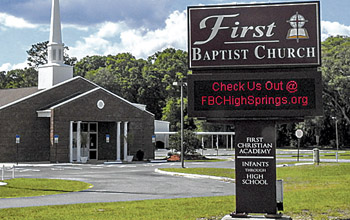
A few smaller churches without web or internet service are offering individual counseling and guidance by email. At least two larger churches, Impact Family Church in High Springs and Alachua First Baptist, have found a unique solution to maintaining the health requirements for their congregations while also still providing the sense of unity and fellowship for members.

They have adopted the concept of the iconic drive-in movie theaters.  Parishioners gather in the church parking lot or field, but stay in their cars to maintain a safe distance, while the pastor broadcasts the sermon via a pre-set radio signal, allowing the congregation to worship safely together.

Most local churches have links on their websites to access or download their online or pre- recorded weekly services for anyone who is interested or needs a place to worship and pray in this uncertain time.

All plan to return to live services as soon as it is safe to do so and the “stay-at-home” sanctions are lifted. In these trying times, prayer and religious solace are needed for many people and the local churches are striving to make sure they provide that while keeping their parishioners safe.

#     #     #

Email RCarson@

alachuatoday.com

Add a comment
Educating Minds, Nourishing Bodies Amid COVID-19

Details
RAY CARSON
Local
25 April 2020
  •  Print 
  • Email

ALACHUA County – The COVID-19 pandemic has changed the way people are living their lives. It has changed the way people work, with many now working from home—or suddenly unemployed. It has changed the way people interact and socialize, with most states issuing “stay at home” orders and social distancing rules. Entertainment time has changed, no more live sports events, music, in-theater movies or socializing in bars or restaurants, no more gatherings of more than 10 people. People have isolated themselves and families to try and control the spread of the virus. This has also affected family life and how children are educated.

On March 17, Florida Commissioner of Education Richard Corcoran announced that schools will be closed through April 15 due to COVID-19. That date was then extended to May 1, which means the new target date for reopening schools is Monday, May 4.

Florida education officials called for each school district to close its doors and move classes online. Despite the recommendation from some officials, Florida Governor DeSantis said it’s possible each county might return to school at different times. This change and uncertainty about reopening has uprooted the traditional education system, putting additional burdens on everyone. Teachers have transitioned their lessons to a remote learning platform, which is available to parents online or through paper packets. If families do not have a computer or device to access online, Alachua County schools are loaning some equipment to help families. If they do not have an internet connection, they can request written lesson packages by contacting the school or teacher. The schools also send out emails to keep parents aware of what is going on.

Healthy Eating Important in Learning Process

Parents are becoming more involved in the teaching process, home schooling their children with the teacher’s guidance. They now have to take command of making sure their children complete the assigned work. For working parents this puts an additional strain both in finding the time to watch over their child's education, and in many cases, if they were working during what was school hours, they could depend on their children getting fed at least one meal during the day. For lower income families, this was often a necessity. Now with high unemployment, many more families have found their income shrink.

Across the nation, schools serve a bigger purpose than just education in children's health and development. Food is important to a child's health and ability to focus. Since children spend an average of six to seven hours of their day in school, lunches need to be provided and every school has a kitchen staff to feed the children. In addition, 38 million Americans live below the poverty level and an equal amount are barely above that, living paycheck to paycheck, and for these children and their parents, school lunch programs are vital.

Federal and state governments have programs to provide funding and resources to schools throughout the nation. The National School Lunch Program (NSLP) is one of several federal resources. The NSLP provided low-cost or free lunches to 29.7 million children daily at a cost of $13.8 billion last year. The Farm to School program matches local farms to school to provide fresh produce for healthier meals to students. Other grants and resources are also available to help schools meet the demand to feed over 56 million school children.

School Meal Distribution Sites

In Alachua County, 18 percent of the population is under 18 and the poverty level is 19.8 percent, which puts a heavier burden on the 47 schools in the district that participate in the Community Eligibility program to provide student meals. When COVID-19 closed all the schools, all school age children lost those lunchtime meals served onsite at the schools. Knowing how important these food programs were to the students, school districts throughout the country scrambled to find ways to get the food to the students. Alachua County Public Schools (ACPS) devised several methods to continue to provide meals in a safe way while following the COVID-19 restrictions. The USDA waived the requirement that all meals had to be eaten on campus and the ACPS set up drive-through meal deliveries for families in need to get food for their children. They also expanded the meal program to include breakfast for the following day.

Children 18 years old and younger can receive free breakfast and lunch from ACPS Food and Nutrition Services Department. The meals will continue to be distributed the entire time while the schools are closed. The ACPS has set up 76 distribution sites throughout Alachua County. That includes schools, community sites and parks, and even stops along school bus routes that serve a large proportion of high-needs students.

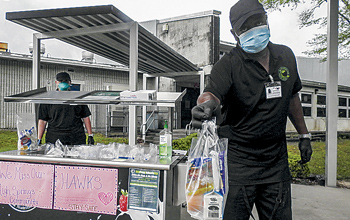
Mondays through Fridays, children receive a cold, grab-and-go lunch for that day and breakfast for the following morning. The cold lunches consist of a sandwich, fruit, crackers, cheese stick and a drink. According to Caron Rowe, a Food Service Specialist with the school board, they decided on cold lunches for safety and preparation ability. “We received a lot of messages from concerned parents about the safety and possible transmission of the virus. By using a drive-up method, they simply drive up, stay in their cars and receive the whole meal in a plastic bag.”

Staff wear face masks and gloves at all times. The prepackaged food allows for less contact with the food and also makes it easier for food service staff to prepare and assemble. “We are used to preparing cooked meals in an onsite kitchen, so this was a learning experience as we went,” said Rowe. “Currently we are serving over 20,000 meals per day at the various locations.” Although much of the food is prepackaged for safety reasons, they are also working with some of the farms in the Farm to School program as well. “We have purchased 3,100 pounds of fresh blueberries from the Clay Ranch Berry Farm that will be added to all the meals for the next three weeks,” said Rowe. Although the schools are currently closed until May 1, that date could be extended. “If it gets extended, we will still be here for the kids as long as we get the supplies. Our staff cares about the students and have big hearts,” Rowe said. “We will be here until life returns to normal and the kids are back in school”

At the 32 schools and eight community sites, meals will be distributed from 11 a.m.-1 p.m. Monday through Friday. At the 15 bus drop-off locations, times will vary depending on the stop and route. Families are urged to check the schedule for bus stop distribution. The district has also received permission from the federal government to provide meals to students to eat over the weekends. Those meals will be given out to students on Fridays. The meals are for all children from 0 to 18. Children do not have to be enrolled at a particular school or program to receive meals. They also do not have to be eligible for free and reduced-price meals during the regular school year to take advantage of the program. If they receive 24-hour notice, the school may be able to provide formula for babies.

More information about the program can be found at https://www.yourchoicefresh.com/, which also contains a list of all available pick up sites and times. Parents can also call their child's school for details and to arrange to get lesson packages.

#     #     #

Email rcarson@

alachuatoday.com

Add a comment

Kids Get Virtual Visits from Miniature Therapy Horses

Details
C.M. WALKER
Local
25 April 2020
  •  Print 
  • Email

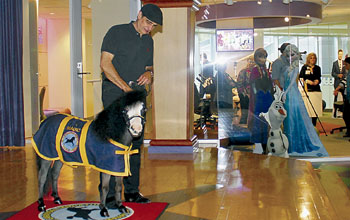
HIGH SPRINGS – How thrilled would any child be to get a FaceTime visit from one of their favorite miniature therapy horses? That’s exactly what’s happening all around the nation as Mr. Jorge and various Gentle Carousel Miniature Therapy Horses drop in for a visit and a story.

With the nation in quarantine, the Gentle Carousel Mini Horses and their caretakers, Jorge and Debbie Garcia-Bengochea, have found ways to help cheer up children and adults in hospitals and rehabilitation centers around the country.

Therapy Horses Practice Social Distancing

“Normally, the charity would be visiting with people one-on-one and preparing for the library programs we do every year,” said Debbie. Since the couple and the therapy horses are observing social distancing along with the rest of the world, they have found innovative ways to continue the therapy program using social media.

In some cases, children have met the therapy horses at a Ronald McDonald House or hospital.  When they return to their home states, the couple and the horses can follow up with them. If they have met a specific horse somewhere, Debbie and Jorge try to have that horse check in with the child via FaceTime.

“People ask us if we’re bored since we can’t leave the farm and volunteers can't come over,” Debbie said. “Far from it. We’re just as busy as ever talking to children using FaceTime in our living room along with the horses.”

In addition, Jorge has been calling some of their long-time supporters and friends just to keep in touch with those he can’t FaceTime.

The organization has about a million social media followers. “Some people are so excited about the telephone calls they post about them on their Facebook pages,” Debbie said. When he calls, they tell him their story. Everyone is facing challenges right now. They get so excited that they call their friends and say, “The real Jorge just called me.”

The couple, other volunteers and the horses returned from New York City just four weeks ago.  They were visiting hospitals and also were at the Javits Convention Center (now a hospital) doing a large international toy festival along with NBC Universal Disney.

“This was a toy fair, which was not open to the public,” said Debbie. The event was open to distributors from all around the world. Children from Make-A-Wish® Foundation as well as terminally ill adults were allowed to attend the event and meet the horses.

As it is unlikely the quarantine will be lifted in time for the charity's normal library visits, they are videotaping “StoryTime on the Farm with Mr. Jorge.”

Jorge will be reading stories that include different horses that usually go to the libraries to visit with the children. “We will have videos of the horses doing some of the things that are included in the story being read to the children,” said Debbie. “It should be really fun for us and for the children,” she said.

The couple is also doing videos for children on things they can do at home…the types of things kids can tune into and enjoy. “We hope that will make their time at home more enjoyable,” said. Debbie.

Major Fundraisers Cancelled

On the down side, the two biggest fundraisers of the year had to be cancelled this year. The 501(c)(3) non-profit organization relies on fundraisers to pay for the work they do. “We don’t charge for our visits,” Debbie said. The Magical Gala, which is usually held at the end of March, was cancelled. In addition, a big Walkathon, which is scheduled for the end of April, has been severely curtailed.

The event is scheduled for the McKethan Brothers Training Center just north of Ocala, the training track used to train Triple Crown winner American Pharaoh. Although the event hasn’t been totally cancelled, it has been so severely downsized as to be a totally different event than was originally planned. Instead of stands full of people, kids who were planning to set up their own lemonade stands, additional horse riders and horse drawn carriages and lots more, there will be two horses walking around the track.

The event will be available for the public to see online, but not in person.  Folks can watch it from home on Facebook. Miniature Therapy Horse Scout, weighing in at no more than 100 lbs., will be walking the track with a 2,000 lb. Percheron named Tiny Prince Charming.

Help by Sponsoring Virtual Walkathon

“If people want to sponsor one of the horses for walking around the track, that would be great,” said Debbie. “People were excited about coming to this event, but social distancing has changed all that.” The horses will begin at the starting gate and go one lap around the track.

The couple is working alone right now. Volunteers are quarantined as well so the couple is busy feeding, grooming and taking care of the horses and other animals on their farm. “Expenses keep on coming. The horses need to be insured, fed and receive the same medical attention as any other time as do the livestock guardian dogs that protect the horses,” said Debbie. “We had counted on the two large fundraisers to help the charity financially, but that’s not going to happen this year,” she said.

Even though these are challenging times, the couple says they are going to continue to look at the positive ways they can send their love out to people. “We are always looking for creative ways to stay positive and send positive care out into the world,” said Debbie.

One item currently in the works is the possibility of the Ryan Seacrest Foundation, another non-profit 501(c)(3) organization dedicated to inspiring today’s youth through entertainment and education-focused initiative, running the Gentle Carousel Miniature Therapy Horses videos and live feed from the farm in their 10 studios located in various hospitals. The horses have visited the studios in person many times over the years.

“We’re still in the talking stages,” said Debbie, “but if it happens, hundreds of children will be able to see the horses and hear Jorge read them stories while they are in the hospital. How wonderful would that be?”

     #     #     #

Email cwalker@

alachuatoday.com

Add a comment

More Articles ...

  1. Virtually Saving Florida's Music Scene
  2. Home at Last from Peru - Stranded Alachua Resident Navigates COVID-19 Outbreak
  3. Mortgage Foreclosure and Eviction Relief
  4. City of Alachua Offers COVID-19 Resource Dashboard
Page 117 of 303
  • Start
  • Prev
  • 112
  • 113
  • 114
  • 115
  • 116
  • 117
  • 118
  • 119
  • 120
  • 121
  • Next
  • End
Alachua County Today Alachua County Today

Explore

  • About Alachua County Today
  • Advertise
  • News
  • Community Calendar
  • Public Notices