
In The Spotlight

Santa brings holiday greetings during the Alachua Christmas parade. Alachua County Today Staff Photographer.
ALACHUA/HIGH SPRINGS – Crisp air, clear skies and a touch of timeless nostalgia set the scene Saturday, Dec. 13, 2025, as the communities of Alachua and High Springs ushered in the holiday season with their annual Christmas parades, filling Main Street in Alachua and later downtown High Springs with festive cheer. This year’s “Charlie Brown Christmas” theme added a warm, reflective tone to the celebrations, blending simple holiday charm with hometown spirit in both cities.
In Alachua, families bundled in sweaters and jackets lined the parade route early, children perched along the curb clutching bags in anticipation of candy and waving at familiar faces passing by. The smell of winter air and the hum of excited conversation filled downtown as the parade stepped off along North Main Street, crossing U.S. Highway 441 under cloudless skies.
A police escort with flashing lights led the procession, followed by Alachua Police Chief Jesse Sandusky, High Springs Police Chief Antoine Sheppard and Alachua County Sheriff Chad Scott, who greeted spectators and waved as they made their way along the route.
Leading the parade as grand marshal was longtime Alachua dentist Dr. Douglas Adel, who was followed by a procession of festively decorated floats, marching bands, community groups and holiday characters that filled Main Street with music and cheer.
The City of Alachua’s official float leaned into the “Charlie Brown Christmas” theme, featuring familiar imagery inspired by the beloved holiday classic — simple decorations, whimsical characters and a nod to the understated spirit of the season — as city commissioners waved from aboard and city staff members passed out sweet treats to children.
The parade showcased a wide cross-section of the community, with floats and walking groups representing local businesses, civic organizations, churches and schools. Participants included Santa Fe Ford, Mi Apa Restaurant, MatchMaker Realty, Momentum Dance Academy, the Mebane High School Alumni Association, the Alachua Business League, Alachua Senior Cha Chas, Capital City Bank, members of the Hare Krishna community, and parade newcomers Ben E. Keith and Chick-fil-A, among many others.
Musical performances added energy and rhythm to the procession. The Mebane Middle School band and the Santa Fe High School Raider Regiment Marching Band performed holiday favorites that echoed through downtown.
Youth sports teams, including Santa Fe Babe Ruth Baseball and the Santa Fe Soccer Academy, proudly represented their programs, walking the route and interacting with the crowd. Volunteers dressed as Peanuts-inspired characters, Santa’s elves and other holiday figures handed out treats and smiles.
Parade judging took place at the intersection of 148th Place and Main Street, where judges evaluated entries for creativity and presentation. Three cash prizes were awarded, with the Alachua Soccer Alliance taking first place and earning $500, Momentum Dance placing second for $300 and Matchmaker Realty finishing third with a $200 award. Parade emcees Damon Messina and Tabitha Jenkins kept the energy high near the judges’ stand, announcing each entry and engaging spectators with commentary as floats rolled past.
Following close behind the horse-drawn entries were the Alachua Parade Pooper Scoopers, representing Capital City Bank and the Alachua Lions Club, who once again performed their familiar and appreciated role of keeping the parade route clean.
The grand finale arrived as Santa Claus appeared atop a firetruck, waving to children who shouted his name and waved back enthusiastically. For many young spectators, the moment marked the official start of the Christmas season.
As night fell, the celebration continued just down the road in High Springs, where the Twilight Christmas Parade transformed downtown into a glowing holiday scene. Floats outlined in twinkling lights rolled beneath the dark sky, while illuminated costumes, flashing decorations and softly lit storefronts created a festive backdrop. Families lined the streets bundled against the evening chill, waving as the parade passed by and enjoying the quieter, storybook feel of the after-dark procession that brought the “Charlie Brown Christmas” theme to life under the stars.
“It really captures the holiday spirit,” said a local resident. “The best part is watching how excited the kids are.”
As crowds dispersed, the feeling lingered — a simple, joyful celebration marked by togetherness, tradition and a reminder that, much like Charlie Brown’s Christmas, the season’s meaning is often found in community.
# # #
Email editor@
alachuatoday.com
Add a comment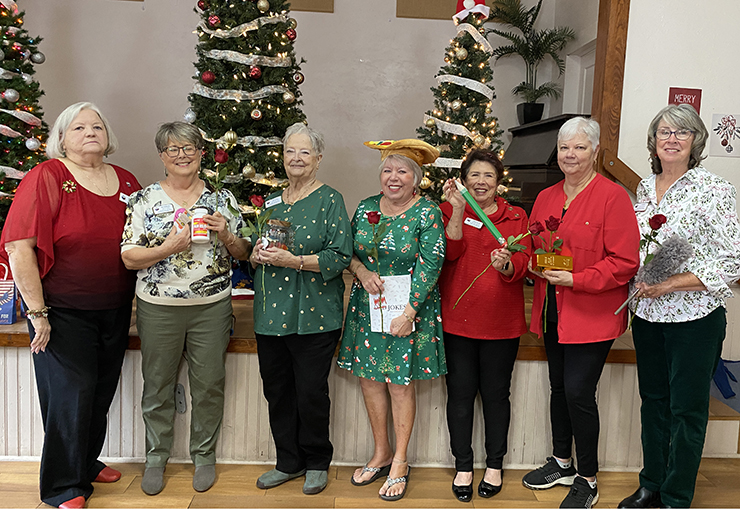
The GFWC District 5 Director installed the new GFWC High Springs New Century Woman’s Club’s Board of Directors for 2026 – 2028. Pictured L-R: Photo - L - R: District 5 Director - Sallie Milner, President - Bonnie Josey, 1st. Vice President - Shirley Macrides, 2nd. Vice President - Vickie Cox, Corresponding Secretary - Marlene Hackland, Treasurer - Mary Sears, Historian - Linda Alexander. Not pictured: Recording Secretary - Pat Carr. \ Photo special to Alachua County Today
HIGH SPRINGS – The GFWC High Springs New Century Woman’s Club marked a milestone recently as its new Board of Directors was formally installed for the 2026–2028 term, signaling continued leadership and service within the community.
The installation ceremony was led by GFWC District 5 Director Sallie Milner, who oversaw the transition and recognized the incoming board members. Each officer received a gift tailored to her role, adding a lighthearted and celebratory touch to the occasion.
Elected to lead the organization as president is Bonnie Josey, who will guide the club’s activities and initiatives over the next two years. She is joined by Shirley Macrides as first vice president and Vickie Cox as second vice president.
Marlene Hackland will serve as corresponding secretary, while Mary Sears takes on the role of treasurer. Linda Alexander was installed as historian, responsible for preserving the club’s records and legacy. Recording Secretary Pat Carr was unable to attend the ceremony and is not pictured.
The High Springs New Century Woman’s Club is part of the General Federation of Women’s Clubs, an international organization dedicated to community improvement through volunteer service. Locally, the club has long been active in civic engagement, charitable projects and educational initiatives that benefit High Springs and surrounding areas.
Club leaders said the installation of the new board reflects both continuity and renewal, as experienced members step into leadership roles while maintaining the club’s long-standing mission of service and advocacy.
The newly installed board will serve through 2028, guiding programming, fundraising and community outreach efforts during the upcoming term.
# # #
email editor@
alachuatoday.com
Add a comment
Players battle for possession during a youth basketball game in Alachua, where more than 220 local children are participating in the community’s winter league./ Photo special to Alachua County Today
ALACHUA – The squeak of sneakers and the echo of bouncing basketballs have returned to the City of Alachua Legacy Multipurpose Center as Alachua’s youth basketball season tips off with record participation, signaling strong community support for youth athletics despite a smaller number of teams this year.
More than 220 children have registered to play this winter through 399 Sports and Recreation, marking one of the largest turnouts the organization has seen and underscoring a growing interest in organized sports among local families. Practices began last week, officially launching what has become a cornerstone of winter recreation in the city.
Although the number of teams is slightly lower than in past seasons, participation has increased, reflecting broader community engagement and sustained enthusiasm for youth basketball. League organizers credit that growth to accessibility and the continued commitment of families, coaches and volunteers.
The league is supported by an entirely volunteer-driven staff through 399 Sports and Recreation, including coaches and support personnel who help ensure a structured, positive experience for young athletes. Their efforts make it possible for children across the community to participate in organized sports during the winter months.
Games will be played on Saturdays, offering a family-friendly schedule for spectators and participants alike. Community members are encouraged to attend games and support players as they build basketball skills while learning teamwork, sportsmanship and discipline.
Volunteers are also needed to assist with concessions during game days. Proceeds from concession sales are reinvested directly into the league and related community programs, helping sustain youth sports opportunities in Alachua.
Beyond competition, the program emphasizes character development, leadership and physical fitness — lessons intended to extend well beyond the basketball season. Through 399 Sports and Recreation, organizers aim to provide a supervised environment where children can build confidence, self-esteem and lifelong values through fair play.
The season will officially begin with Opening Ceremonies on Saturday, Jan. 10, 2026, from 9 to 10 a.m. at the Legacy Multipurpose Center. The event will introduce teams to the community, followed by games throughout the day.
Game schedules will be posted on league and city social media platforms and websites as the season progresses. Additional information is available by contacting 399sportsrecreation@gmail.com.
# # #
email editor@
alachuatoday.com
Add a comment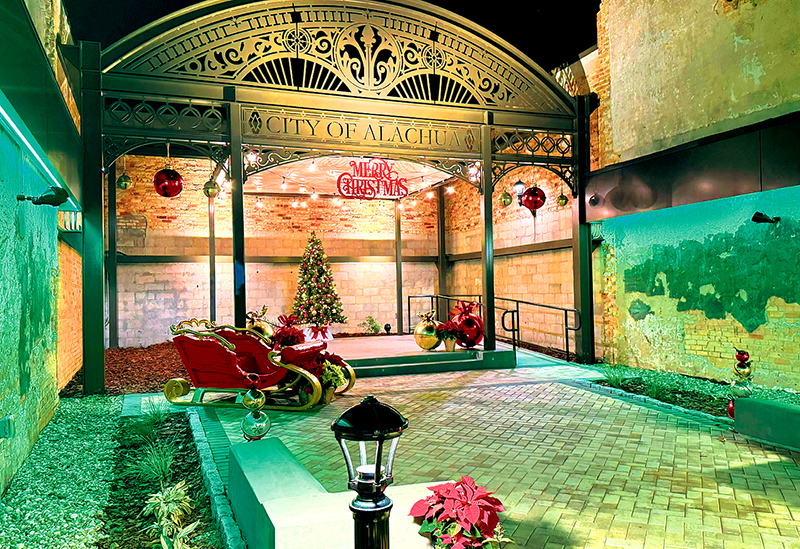
Theatre Park renovations were funded in part by a $50,000 T-Mobile Hometown Grant awarded earlier this year and delivers on a multi-year vision to rebuild the park from the ground up. / Today Staff Photographer
ALACHUA ‒ Downtown Alachua was awash in twinkling lights, music, and holiday cheer Friday, Dec. 5, 2025, as crowds gathered for the city’s annual Christmas on Main celebration and tree lighting. This year’s event delivered all the traditions residents have come to love — snow play, crafts, carriage rides, and live performances — but also featured a major new addition: the long-awaited grand reopening of Theatre Park, revealed to the public for the first time since its full reconstruction.
Families began filling Main Street at 4:30 p.m., weaving between activity stations, craft tables, ornament-making booths, and local businesses that stayed open late to welcome visitors. Children lined up for bounce houses, face painting, and the ever-popular snow playground, while the aroma of cocoa and holiday treats drifted along the decorated corridor. As dusk settled, the downtown Christmas tree near Skinner Park was lit during a lively countdown, officially ushering in the season.
A New Stage for Main Street
One of the evening’s standout features was the debut of a dedicated performance stage — a first for Christmas on Main. Throughout the night, crowds gathered as Dance Alive, IndepenDance, Momentum Dance, Okito, and the Mebane Middle School Chorus brought nonstop entertainment to the street. Their high-energy routines and choral performances added a professional, celebratory atmosphere to this year’s event and kept spectators spilling into the surrounding sidewalks. The new stage was especially symbolic given its connection to the fully renovated Theatre Park just steps away.
Theatre Park Makes Its Holiday Entrance
For the first time since construction began, residents were able to step inside the redesigned Theatre Park —a striking combination of restored historic brick, new clay-fired pavers, Florida-friendly landscaping, and the park’s signature wrought-iron archway lit in warm red hues for the holiday season. Poinsettias, ornaments, and a glowing Christmas tree created an inviting scene, and visitors filled the space quickly, many pausing for photos under the “Merry Christmas” sign suspended inside the gateway.
The renovation — funded in part by a $50,000 T-Mobile Hometown Grant awarded earlier this year — delivers on a multi-year vision to rebuild the park from the ground up. Structural repairs, enhanced lighting, and a permanent stage area now make Theatre Park a functional venue for community gatherings, small concerts, theatre groups, and seasonal events.
For longtime residents familiar with the park’s deteriorating condition before reconstruction, Friday night marked a milestone. What once was an overgrown, flood-prone space is now an attractive, usable centerpiece of downtown — unveiled at the city’s most cherished holiday tradition.
Holiday Magic Up and Down Main Street
While Theatre Park captured significant attention, Christmas on Main offered festive experiences throughout the entire corridor. A violinist near the florist shop provided soft holiday music as families strolled between businesses. Children created reindeer food, decorated ornaments, and played games at stations sponsored by civic groups, local shops, and community volunteers.
Snow machines sent flurries drifting above the street once again — drawing delighted shrieks from children who leapt and spun beneath the sparkling cascade. Carriage rides rolled steadily throughout the evening, offering a nostalgic way to take in the decorated storefronts and vibrant crowds.
The Chamber of Commerce, which organizes the annual event in partnership with the City of Alachua and local sponsors, described the night as one of the most successful Christmas on Main celebrations yet.
“This year was truly special,” the Chamber shared. “The reopening of Theatre Park, the new performance stage, and the overwhelming support of our community made the evening unforgettable.”
A Tradition Growing Stronger
With the park now complete, both the City and the Chamber anticipate it will serve as a central venue for future downtown events — bringing renewed vibrancy to historic Main Street.
As families headed home Friday night with crafts in hand and holiday music still echoing through the corridor, one thing was clear: Christmas on Main continues to be a highlight of the season, and this year’s celebration marked the beginning of a new chapter for downtown Alachua.
# # #
Email editor@
alachuatoday.com
Add a comment
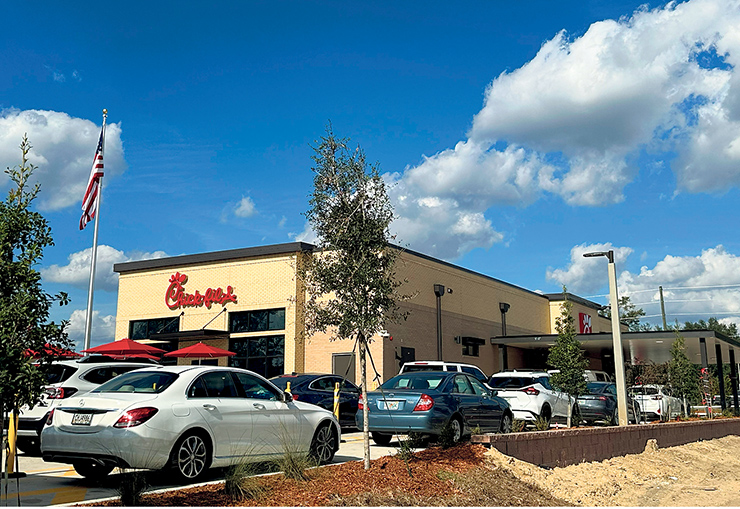
Customers line up outside the new Chick-fil-A in Alachua. The restaurant drew steady drive-thru and dine-in traffic as residents welcomed the city’s newest fast-food addition. / Today Staff Photographer
More News

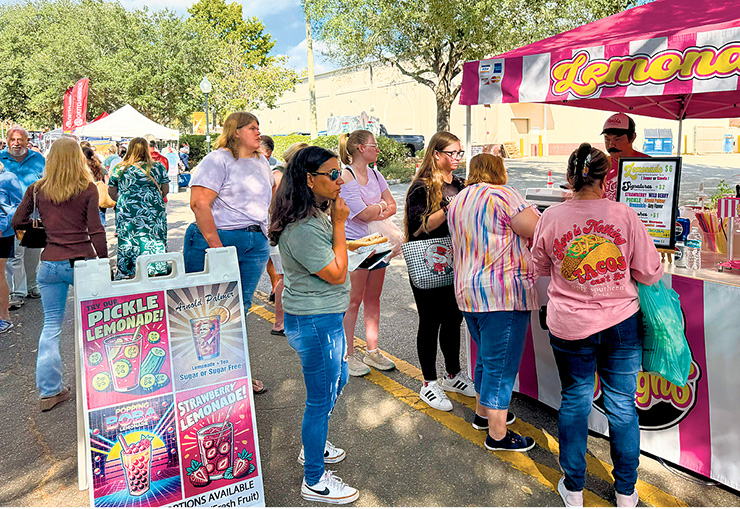
A steady stream of visitors packs Main Street as local businesses, artisans and food vendors showcase their offerings at the 2025 Fall Festival. / Alachua County Today Staff Photographer
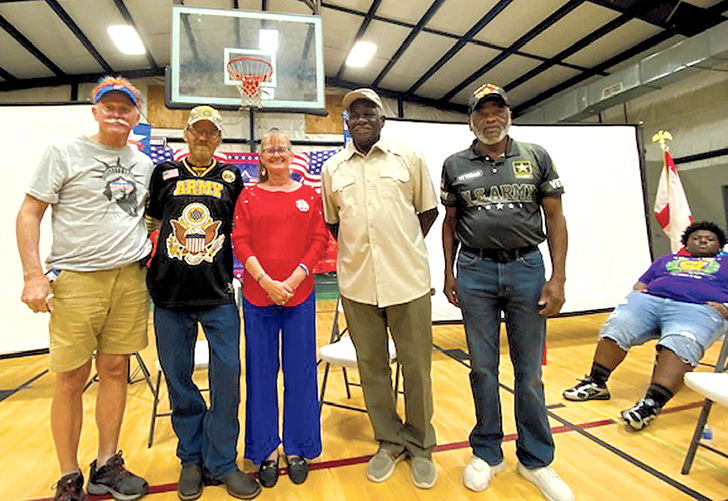
Retired Alachua City Mayor Gib Coerper (Navy, Ret.), Jackson Gold Star Family, Horace Jenkins (Navy) and Major (Ret.) Charlie Jackson / Photo special to Alachua County Today
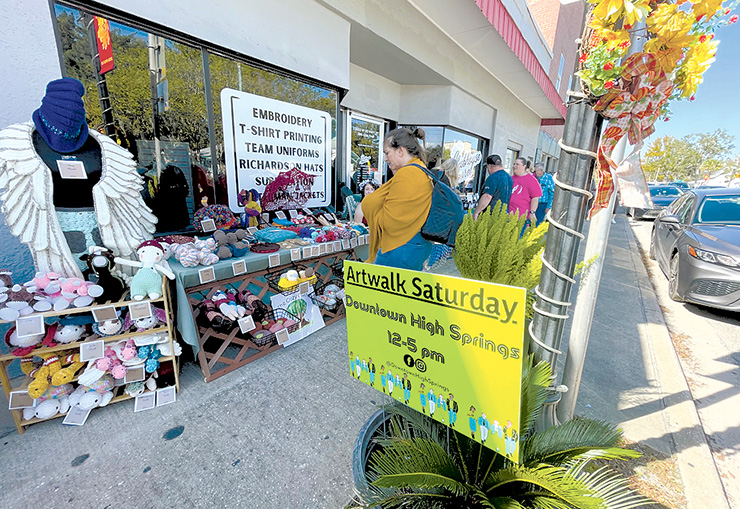


Trick-or-Treaters fill Main Street in Alachua during the city’s annual Halloween celebration, weaving through crowds under festive lights as local businesses hand out candy and families take in the lively holiday atmosphere. / Photo special to Alachua County Today
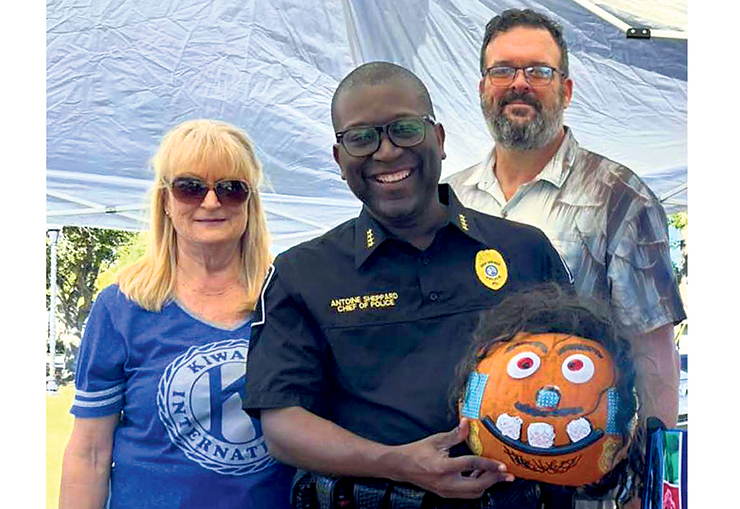
Families and participants enjoyed the sixth annual pumpkin decorating contest in downtown High Springs on Friday. The event, hosted by the Kiwanis Club of Santa Fe, brought out community members for Halloween fun and treats. / Photo special to Alachua County Today
Santa brings holiday greetings during the Alachua Christmas parade. Alachua County Today Staff Photographer.
ALACHUA/HIGH SPRINGS – Crisp air, clear skies and a touch of timeless nostalgia set the scene Saturday, Dec. 13, 2025, as the communities of Alachua and High Springs ushered in the holiday season with their annual Christmas parades, filling Main Street in Alachua and later downtown High Springs with festive cheer. This year’s “Charlie Brown Christmas” theme added a warm, reflective tone to the celebrations, blending simple holiday charm with hometown spirit in both cities.
In Alachua, families bundled in sweaters and jackets lined the parade route early, children perched along the curb clutching bags in anticipation of candy and waving at familiar faces passing by. The smell of winter air and the hum of excited conversation filled downtown as the parade stepped off along North Main Street, crossing U.S. Highway 441 under cloudless skies.
A police escort with flashing lights led the procession, followed by Alachua Police Chief Jesse Sandusky, High Springs Police Chief Antoine Sheppard and Alachua County Sheriff Chad Scott, who greeted spectators and waved as they made their way along the route.
Leading the parade as grand marshal was longtime Alachua dentist Dr. Douglas Adel, who was followed by a procession of festively decorated floats, marching bands, community groups and holiday characters that filled Main Street with music and cheer.
The City of Alachua’s official float leaned into the “Charlie Brown Christmas” theme, featuring familiar imagery inspired by the beloved holiday classic — simple decorations, whimsical characters and a nod to the understated spirit of the season — as city commissioners waved from aboard and city staff members passed out sweet treats to children.
The parade showcased a wide cross-section of the community, with floats and walking groups representing local businesses, civic organizations, churches and schools. Participants included Santa Fe Ford, Mi Apa Restaurant, MatchMaker Realty, Momentum Dance Academy, the Mebane High School Alumni Association, the Alachua Business League, Alachua Senior Cha Chas, Capital City Bank, members of the Hare Krishna community, and parade newcomers Ben E. Keith and Chick-fil-A, among many others.
Musical performances added energy and rhythm to the procession. The Mebane Middle School band and the Santa Fe High School Raider Regiment Marching Band performed holiday favorites that echoed through downtown.
Youth sports teams, including Santa Fe Babe Ruth Baseball and the Santa Fe Soccer Academy, proudly represented their programs, walking the route and interacting with the crowd. Volunteers dressed as Peanuts-inspired characters, Santa’s elves and other holiday figures handed out treats and smiles.
Parade judging took place at the intersection of 148th Place and Main Street, where judges evaluated entries for creativity and presentation. Three cash prizes were awarded, with the Alachua Soccer Alliance taking first place and earning $500, Momentum Dance placing second for $300 and Matchmaker Realty finishing third with a $200 award. Parade emcees Damon Messina and Tabitha Jenkins kept the energy high near the judges’ stand, announcing each entry and engaging spectators with commentary as floats rolled past.
Following close behind the horse-drawn entries were the Alachua Parade Pooper Scoopers, representing Capital City Bank and the Alachua Lions Club, who once again performed their familiar and appreciated role of keeping the parade route clean.
The grand finale arrived as Santa Claus appeared atop a firetruck, waving to children who shouted his name and waved back enthusiastically. For many young spectators, the moment marked the official start of the Christmas season.
As night fell, the celebration continued just down the road in High Springs, where the Twilight Christmas Parade transformed downtown into a glowing holiday scene. Floats outlined in twinkling lights rolled beneath the dark sky, while illuminated costumes, flashing decorations and softly lit storefronts created a festive backdrop. Families lined the streets bundled against the evening chill, waving as the parade passed by and enjoying the quieter, storybook feel of the after-dark procession that brought the “Charlie Brown Christmas” theme to life under the stars.
“It really captures the holiday spirit,” said a local resident. “The best part is watching how excited the kids are.”
As crowds dispersed, the feeling lingered — a simple, joyful celebration marked by togetherness, tradition and a reminder that, much like Charlie Brown’s Christmas, the season’s meaning is often found in community.
# # #
Email editor@
alachuatoday.com
Add a comment
The GFWC District 5 Director installed the new GFWC High Springs New Century Woman’s Club’s Board of Directors for 2026 – 2028. Pictured L-R: Photo - L - R: District 5 Director - Sallie Milner, President - Bonnie Josey, 1st. Vice President - Shirley Macrides, 2nd. Vice President - Vickie Cox, Corresponding Secretary - Marlene Hackland, Treasurer - Mary Sears, Historian - Linda Alexander. Not pictured: Recording Secretary - Pat Carr. \ Photo special to Alachua County Today
HIGH SPRINGS – The GFWC High Springs New Century Woman’s Club marked a milestone recently as its new Board of Directors was formally installed for the 2026–2028 term, signaling continued leadership and service within the community.
The installation ceremony was led by GFWC District 5 Director Sallie Milner, who oversaw the transition and recognized the incoming board members. Each officer received a gift tailored to her role, adding a lighthearted and celebratory touch to the occasion.
Elected to lead the organization as president is Bonnie Josey, who will guide the club’s activities and initiatives over the next two years. She is joined by Shirley Macrides as first vice president and Vickie Cox as second vice president.
Marlene Hackland will serve as corresponding secretary, while Mary Sears takes on the role of treasurer. Linda Alexander was installed as historian, responsible for preserving the club’s records and legacy. Recording Secretary Pat Carr was unable to attend the ceremony and is not pictured.
The High Springs New Century Woman’s Club is part of the General Federation of Women’s Clubs, an international organization dedicated to community improvement through volunteer service. Locally, the club has long been active in civic engagement, charitable projects and educational initiatives that benefit High Springs and surrounding areas.
Club leaders said the installation of the new board reflects both continuity and renewal, as experienced members step into leadership roles while maintaining the club’s long-standing mission of service and advocacy.
The newly installed board will serve through 2028, guiding programming, fundraising and community outreach efforts during the upcoming term.
# # #
email editor@
alachuatoday.com
Add a comment
Players battle for possession during a youth basketball game in Alachua, where more than 220 local children are participating in the community’s winter league./ Photo special to Alachua County Today
ALACHUA – The squeak of sneakers and the echo of bouncing basketballs have returned to the City of Alachua Legacy Multipurpose Center as Alachua’s youth basketball season tips off with record participation, signaling strong community support for youth athletics despite a smaller number of teams this year.
More than 220 children have registered to play this winter through 399 Sports and Recreation, marking one of the largest turnouts the organization has seen and underscoring a growing interest in organized sports among local families. Practices began last week, officially launching what has become a cornerstone of winter recreation in the city.
Although the number of teams is slightly lower than in past seasons, participation has increased, reflecting broader community engagement and sustained enthusiasm for youth basketball. League organizers credit that growth to accessibility and the continued commitment of families, coaches and volunteers.
The league is supported by an entirely volunteer-driven staff through 399 Sports and Recreation, including coaches and support personnel who help ensure a structured, positive experience for young athletes. Their efforts make it possible for children across the community to participate in organized sports during the winter months.
Games will be played on Saturdays, offering a family-friendly schedule for spectators and participants alike. Community members are encouraged to attend games and support players as they build basketball skills while learning teamwork, sportsmanship and discipline.
Volunteers are also needed to assist with concessions during game days. Proceeds from concession sales are reinvested directly into the league and related community programs, helping sustain youth sports opportunities in Alachua.
Beyond competition, the program emphasizes character development, leadership and physical fitness — lessons intended to extend well beyond the basketball season. Through 399 Sports and Recreation, organizers aim to provide a supervised environment where children can build confidence, self-esteem and lifelong values through fair play.
The season will officially begin with Opening Ceremonies on Saturday, Jan. 10, 2026, from 9 to 10 a.m. at the Legacy Multipurpose Center. The event will introduce teams to the community, followed by games throughout the day.
Game schedules will be posted on league and city social media platforms and websites as the season progresses. Additional information is available by contacting 399sportsrecreation@gmail.com.
# # #
email editor@
alachuatoday.com
Add a commentHIGH SPRINGS – The High Springs Community Redevelopment Agency on Thursday reviewed three business items and explored a new proposal aimed at strengthening the connection between the city’s popular natural springs and its downtown core.
During the Dec. 11, 2025, meeting, the CRA heard a presentation outlining a potential free shuttle service that would transport visitors between several nearby springs and downtown High Springs during peak tourism months. The concept was presented by John Millett, one of the owners of the recently opened Serendipity Sodas & Sweets.
Millett noted that 24 springs are located within 12 miles of High Springs, drawing thousands of visitors to the area each year. However, once visitors enter the springs on busy weekends, they often remain there for the day rather than venturing into town.
“Once someone gets to the springs, they are not able to leave and come back again during the weekend,” Millett said.
The proposed shuttle would operate on weekends from March through September, running from 9 a.m. to 7 p.m. Millett outlined two routes — a western loop serving Poe, Blue and Ginnie springs, and a northern loop serving Ichetucknee Springs and Rum Island. Shuttles would return to downtown approximately every 30 minutes, stopping in front of the High Springs Chamber of Commerce.
“Every half hour they would be returning to downtown High Springs in front of the Chamber building to drop off people,” Millett said. “People could come to town for shopping or lunch and then hop back on the shuttle and get back to their cars and the parks.”
CRA Manager Amy Bohannon expressed support for the idea, saying it could help draw visitors into the downtown area and support local businesses. She said there may be sufficient funding within the CRA budget to initiate the project.
“There might be enough money in the CRA to get this project started,” Bohannon said.
Millett said the estimated cost for the shuttle service ranges from $15,000 to $20,000, with additional plans to offset expenses by selling advertising space on the sides of the shuttle vans. He said several downtown business owners have expressed interest in contributing financially.
“I have talked with several business owners in town and they are into chipping in to help carry the financial burden,” Millett said.
Millett said the shuttle vehicles would be owned by the organizers, with insurance under their name, but he requested reimbursement for insurance costs. He estimated that $30,000 would cover fuel, driver salaries and insurance for one year. Both Millett and Bohannon noted that similar shuttle programs are already in place in other CRA districts throughout Florida.
City Manager Jeremy Marshall said he wanted direction from the CRA Board before staff devoted further time to developing the proposal. Board members responded favorably, signaling interest in exploring the concept further. The proposal is expected to return to the board once details and financing are refined.
In other business, the CRA unanimously approved a Commercial Façade Grant application from the Howard T. Odum Florida Springs Institute, located at 18645 High Springs Main Street. The institute plans to paint the front of the building, repair trim and install a Florida Springs Welcome Center sign previously discussed by the board.
The total project cost is estimated at $7,500, with a requested grant of $3,750, representing 50 percent of the total. Bohannon said approval is contingent upon the project also receiving a Certificate of Appropriateness from the Historic Preservation Board.
The board also unanimously approved a second Commercial Façade Grant request from the GFWC High Springs New Century Woman’s Club. The project includes the design and installation of a two-sided sign and construction of a 7-foot-by-7-foot deck with stairs, handrails and a bench at the rear entrance of the building. The total project cost is $4,977, with a requested grant of $2,488.64.
Additionally, the board approved an updated interlocal agreement related to an innovative policing initiative first approved in September. The agreement allows for an increased cost of an electric bicycle dedicated to policing efforts within the CRA district and enhanced police services during peak hours. The cost of the electric bike increased from $5,500 to $5,800 and was approved unanimously.
At the close of the meeting, board members acknowledged the retirement of High Springs Police Department Sgt. Gary Moore, who was working his final shift. The board thanked him for his service to the community and wished him well.
Earlier in the meeting, the board also recognized the recent death of Sonny Tillman, offering a moment of silence and condolences to his family.
# # #
Email cwalker@
alachuatoday.com
Add a commentHIGH SPRINGS – The High Springs Art Walk returns to historic downtown on Saturday, Dec. 20, 2025, offering residents and visitors a seasonal opportunity to experience local art, small businesses and the city’s walkable charm.
The event will take place from noon to 5 p.m. and will feature between 15 and 20 local artists and makers displaying their work along downtown sidewalks. Artists will set up in front of storefronts, creating an open-air gallery that allows attendees to browse, meet creators and purchase original artwork throughout the afternoon.
Organizers say the Art Walk is designed to celebrate creativity while supporting both artists and downtown businesses. In addition to artist displays, participating merchants will offer special promotions and sales, encouraging visitors to explore the area’s shops and restaurants.
The event also provides an interactive component for attendees. Lanza Gallery & Art Supplies will host “Art Testing” stations from noon to 3 p.m., inviting guests to try new art products while enjoying light refreshments. The hands-on experience is intended to appeal to artists of all skill levels as well as those interested in learning more about creative tools and materials.
The Art Walk has become a popular feature of High Springs’ seasonal calendar, highlighting the city’s growing arts scene and its reputation as a welcoming destination for creatives. The combination of art, food and locally owned businesses reflects the community’s emphasis on supporting small enterprises and fostering a vibrant downtown environment.
Artists and creators interested in participating in future Art Walk events are encouraged to contact organizers by emailing downtownhighsprings@gmail.com and including photos of their work for consideration.
For customer or media inquiries related to the event, Unique Notions can be reached at 352-318-5719, and Lanza Gallery & Art Supplies can be reached at 352-474-1049. Additional updates and information are available through the official Downtown High Springs Facebook page.
# # #
email editor@
alachuatoday.com
Add a commentALACHUA – A 43-year-old homeless woman was arrested Monday evening after police say she vandalized a pickup truck following an argument with its owner in the parking lot of an Alachua restaurant.
According to an arrest report from the Alachua Police Department, officers were called at about 7:05 p.m. on Dec. 8, 2025, to Sonny’s BBQ, located at 15935 N.W. U.S. Highway 441, in response to a report of an armed disturbance. The caller reported that a woman armed with a knife was threatening to slash the tires of his vehicle.
An officer arrived at the scene and made contact with the victim, who pointed out the suspect, later identified as Janelle-Joy Alexandra Summers, as she was driving out of the parking lot. The officer conducted a traffic stop and detained Summers, removing her from the vehicle and placing her in handcuffs.
Police reported recovering a knife clipped to the right side of Summers’ pants.
The victim told officers he had dated Summers intermittently for several years and had agreed to meet her at the restaurant. He said that when she arrived, she appeared to be in a manic state and became angry, yelling inside the restaurant. Employees asked her to leave the dining area, according to the report.
After leaving the restaurant, Summers allegedly sent the victim a series of text messages, including one threatening to slash the tires on his pickup truck.
The officer reported observing deep scratches along one side of the victim’s gray Chevrolet Silverado, as well as multiple messages written on the vehicle in nail polish. One of the messages reportedly included the word “die.”
After being advised of her Miranda rights, Summers reportedly admitted she was upset with the victim and acknowledged that she used a pocket knife to scratch the vehicle and wrote messages on it using nail polish.
Summers is described in the arrest report as homeless. She was charged with property damage of $1,000 or more, a felony offense. While she has an unspecified criminal history in other counties between 2021 and 2025, court records indicate she has no prior criminal convictions.
Judge Susan Miller-Jones set Summers’ bail at $15,000 but ordered that she be released if accepted into Mental Health Court. The judge also ordered an evaluation to determine whether Summers requires emergency mental health treatment.
# # #
Email cwalker@
alachuatoday.com
Add a commentTALLAHASSEE – On Dec. 18, 2025, Governor Ron DeSantis announced a total of $311 million in awards to improve infrastructure in 37 Florida communities, which includes 32 awards to rural counties and small cities. These awards come from funding through both the Community Development Block Grant-Disaster Recovery (CDBG-DR) Infrastructure Repair Program, helping communities impacted by the 2023 and 2024 Storms—Hurricanes Idalia, Debby, Helene, Milton and the 2024 North Florida Tornadoes and funding from the Rural Infrastructure Fund (RIF). These awards invest in critical infrastructure needs ranging from utility and transportation improvements to emergency operations resources in these communities—especially supporting critical water infrastructure investments across the state.
“Today in Highlands County, I was proud to announce $311 million in grant awards to improve infrastructure in 37 communities across Florida impacted by the major storms of 2023 and 2024—Hurricanes Idalia, Debby, Helene, Milton and the North Florida Tornadoes,” said Governor Ron DeSantis. “These infrastructure projects will help make Florida more prosperous, more resilient, and better prepared to weather any storms that may come our way.”
“These awards directly support job creation by providing communities with the critical infrastructure to embolden their vision for resiliency and business formation,” said Florida Secretary of Commerce J. Alex Kelly. “Whether it’s upgrading utilities, developing pad ready manufacturing sites, or improving essential services, these projects help small and rural communities attract job creators, bolster their workforce and build a thriving economic future.”
The following communities will receive funds through the 2023 and 2024 Storms Community Development Block Grant-Disaster Recovery (CDBG-DR) Infrastructure Repair Program:
- Bradford County Board of County Commissioners ($5,951,403) - to structurally reinforce the roadway by adding base, pavement and re-establish the roadside swales by regrading and adding erosion protection.
- Citrus County Board of County Commissioners ($16,435,400) – to support the replacement of a sanitary sewer system following stormwater intrusion and increased flows caused by the 2023 and 2024 storms. Upgrading these systems will expand capacity and help alleviate long-standing constraints on the county’s ability to grow, supporting future business development.
- City of Arcadia
o $14,233,044 – to widen the main stormwater channel in the city, providing additional storage during storms.
o $8,514,000 – to construct and expand the wastewater treatment plant. - City of Live Oak ($3,895,500) – to construct a 100,000-gallon water storage tank and support a water line loop project.
- City of Macclenny ($7,028,700) – to harden and modernize the Ohio Street Water Treatment Plant by upgrading and improving software and equipment.
- City of Palatka ($4,932,396) - to harden and expand the capacity of the city’s wastewater treatment plant to handle future wet weather surges.
- City of Wauchula ($2,386,500) – to support wastewater system repairs, rehabilitation and floodwater mitigation.
- Columbia County Board of County Commissioners ($4,000,000) – to upgrade and harden community shelters in Columbia County.
- DeSoto County Board of County Commissioners ($8,000,000) – to construct and install wells and a pumping system to connect the wastewater treatment plant to the disposal wells—providing a more secure, underground disposal method for treated wastewater.
- Hardee County Board of County Commissioners ($1,900,000) – to remove vegetative debris from the Peace River Waterway system.
- Jacksonville Electric Authority ($20,000,000) – to redirect all wastewater flows to Jacksonville Electric Authority’s existing, reliable wastewater treatment facility.
- Okeechobee County Board of County Commissioners ($2,720,000) – to rehabilitate, preserve and harden five critical county-owned bridges.
- Peace River Watershed Project ($70,000,000) – to support the water infrastructure repair project in Polk County—ensuring restoration and resiliency that manages flood risk and water quality impairment through habitat restoration.
- Santa Fe College ($5,000,000) – to repair and upgrade the campus gymnasium due to significant roof damage from the 2023 and 2024 Storms.
- Sebring Airport Authority ($3,044,630) – to demolish and replace the existing stormwater system and associated infrastructure at Sebring Regional Airport and Multimodal Logistics Center.
- Suwannee County Board of County Commissioners ($38,044,115) – to construct the North Florida Regional Special Needs Emergency Shelter.
- Town of Glen St. Mary ($1,339,500) – to harden the wastewater collection system by installing permanent standby generators for the sanitary sewer lift stations.
- Town of St. Lucie Village ($12,124,812) – to construct a resilient, centralized potable water supply system for the town’s public use.
- Union County Board of County Commissioners ($1,401,750) – to construct a hardened public safety communications tower and upgrade the county’s current emergency dispatch system.
- Village of Indiantown
o $9,300,000 – to construct a new Reverse Osmosis water treatment plant, replacing existing outdated systems.
o $7,900,000 – to replace 13,000 linear feet of the main water transmission main for the Village.
In addition to the $400 million in IRP funding, an allotment of $50 million has been allocated by HUD to eligible counties and municipalities located in 2023 and 2024 Storms' Most Impacted and Distressed (MID) areas affected by Hurricane Ian.
The following communities will receive funds under both Hurricane Ian and the 2023 and 2024 Storms Community Development Block Grant (CDBG-DR) Infrastructure Repair Program:
- City of Avon Park ($22,248,529) – to assess, evaluate, repair, sleeve or rebuild the facilities at the City of Avon Park’s Sanitary Sewer Collection System.
- Immokalee Water and Sewer District ($10,823,000) – to improve the existing wastewater treatment plant, addressing hydraulic imbalances, enhancing treatment reliability and providing surge capacity necessary to manage extreme wet-weather inflows.
- Town of Dundee
o $6,008,781 – to harden the town’s sanitary sewer collection system and install monitoring equipment at the town’s wastewater treatment plant.
o $10,257,429 – to repair damage and harden the town’s potable water system.
The RIF program supports infrastructure projects that drive job creation, capital investment, and strengthen economies in Rural Areas of Opportunity (RAO), rural counties and rural communities. For Fiscal Year (FY) 2025-2026, the Florida Legislature appropriated $17 million for the RIF statewide program and $5 million for the Panhandle-Specific program for a total of $22 million. FloridaCommerce received a record 112 applications requesting more than $195 million in funding during the 2025-2026 RIF application period. Since 2019, the program has awarded more than $110 million in grant funds.
The following communities will receive funds through the Rural Infrastructure Fund Program:
- City of Frostproof ($238,991) – to extend an existing water main, designing a 12-inch loop allowing for extension to the area proposed as the Duke Readiness Center.
- City of Lake City ($1,788,415) – to replace a hangar at the Lake City Gateway Airport significantly damaged by Hurricane Idalia.
- City of Okeechobee ($1,200,000) – to support a construction project aimed at improving public infrastructure, facilitating expansion within an existing industrial site, including the resurfacing of two major roads that provide access to the Okeechobee Commerce Center.
- City of Wauchula ($510,000) – to enhance the existing water distribution system by installing approximately 7,100 linear feet of water main, enhancing fire protection along Townsend Street to U.S. Highway 17.
- Columbia County Board of County Commissioners ($2,000,000) – to construct an inbound and outbound rail track serving the North Florida Mega Industrial Park.
- Hardee County ($250,000) – to build a dewatering facility, reducing long-term disposal costs.
- Hardee County Industrial Development Authority ($226,250) – to continue their centralized parking construction, including the relocation of electrical utilities underground.
- Keystone Heights Airport Authority ($2,950,450) – to construct a runway extension to Runway 2.
- Okeechobee Utility Authority ($1,000,000) – to install pipe and corresponding water mains to connect previously completed water infrastructure.
- Putnam County Board of County Commissioners ($3,000,000) – to construct and commission critical public infrastructure at the Central Landfill in Putnam County.
- Town of Zolfo Springs ($300,000) – to conduct a comprehensive Sanitary Sewer Evaluation Survey which will identify infiltration and inflow sources and address challenges from power outages, lift station failures and aging infrastructure.
# # #
email editor@
alachuatoday.com
Add a comment
TALLAHASSEE – Florida students are invited to take part in the 2025 Native American Heritage Month art and essay contests, celebrating this year’s theme: “Celebrating Florida’s Native American Heritage,” according to an announcement Thursday from the Florida Department of Education and Volunteer Florida.
Native American Heritage Month is observed nationwide each November and serves as a time to acknowledge the cultural, historical and artistic contributions of Native Americans. This year’s contests are designed to encourage students across all grade levels to explore and share stories of Florida’s Native American leaders, artists and historical figures.
“We are proud to offer students opportunities to learn from and honor the Native Americans who have shaped Florida’s story,” said Commissioner of Education Anastasios Kamoutsas. “I encourage every student to learn about our Native American history and discover the remarkable achievements they made.”
Volunteer Florida CEO Josie Tamayo echoed the message, stating, “I am proud to celebrate the culture and heritage of Native Americans who enrich the value of our Nation. During Native American Heritage Month, we honor the many contributions of Native American Floridians.”
Art Contest Details
All Florida students are eligible to participate. Students in grades K–3 may enter the art contest by submitting one original, two-dimensional piece of artwork reflecting this year’s theme. Four statewide winners will be selected, with each receiving a $200 gift card for school supplies and a one-year pass to Florida State Parks.
Essay Contest Details
Students in grades 4–12 may enter the essay contest. Six winners will be chosen—two from each grade level group (4–5, 6–8, 9–12). Each winning essayist will receive a two-year Florida College Plan scholarship from the Florida Prepaid College Foundation and a $200 school-supply gift card. Essays must be written in English, no longer than 500 words, and focus on a Native American Floridian who has had a meaningful impact on the state’s history or culture.
Examples of suggested subjects include Betty Mae Tiger Jumper, the first woman elected Chair of the Seminole Tribe of Florida; Ulele, sometimes referred to as “Florida’s Timucuan Pocahontas”; Osceola, a prominent advocate for Seminole rights in the 1800s; and Noah Billie, a noted Seminole painter.
Excellence in Education Award
The Governor’s Native American Heritage Month Excellence in Education Award is open to all full-time educators in Florida’s elementary, middle and high schools. Four winners will be selected. Nominations may be submitted by teachers, principals, parents, guardians or students. Winners will receive $2,500 from Volunteer Florida.
How to Enter
Contest entry forms and educator nomination forms may be submitted online or mailed to:
Volunteer Florida
Native American Heritage Month Committee
1545 Raymond Diehl Road, Suite 250
Tallahassee, Florida 32308
All entries must be received by 5 p.m. Eastern Time on Friday, Nov. 21, 2025. Additional information is available at www.floridanativeamericanheritage.com.
# # #
Email cwalker@
alachuatoday.com
Add a commentJACKSONVILLE, Fla. —Today, Governor Ron DeSantis and First Lady Casey DeSantis announced Florida awards $30 million in grant funding to four specialty children’s hospitals in Florida to develop and improve access to clinical trials, advance treatment protocols, and discover cures for childhood cancer. Johns Hopkins All Children’s Hospital in St. Petersburg, Nemour’s Children’s Hospital in Orlando, Nicklaus Children’s Hospital in Miami, and Wolfson Children’s Hospital in Jacksonville were each awarded $7.5 million.
“Since I became governor, Florida has invested more than $1 billion in cancer research and treatment—a 114% increase. We created the Cancer Connect Collaborative Research Incubator program within the Florida Department of Health this year to enhance cancer research throughout Florida,” said Governor Ron DeSantis. “Four of Florida’s top children’s hospitals have received a total of $30 million in funding for their innovative proposals to help children and adolescents who are fighting cancer. By investing in statewide infrastructure for pediatric cancer initiatives, we aim to eliminate the need for Florida families to travel out of state for potentially life-saving experimental therapies and specialized care.”
The Cancer Connect Collaborative Research Incubator was created in 2025 to further Florida efforts as a leader in cancer research and treatment. The Incubator is funded with $30 million and will focus on pediatric cancer in its first five-year funding cycle. While pediatric cancer accounts for just one percent of cases nationally, Florida’s pediatric cancer population is significant, with the state accounting for six percent of all new pediatric cancer cases in the U.S., thereby impacting thousands of children and families every year.
“Research Incubator investments to advance research, prevention, and treatment for pediatric cancer represents a meaningful step forward in our mission to improve outcomes, strengthen families, and ensure that every child has access to the most advanced care possible right here in Florida,” said First Lady Casey DeSantis. “I’m deeply grateful to Governor DeSantis for his unwavering leadership and commitment to advancing cancer research in Florida.”
“Thanks to the vision and leadership of First Lady Casey DeSantis, Florida continues to set the national standard for advancing adult and childhood cancer research and care,” said State Surgeon General Dr. Joseph A Ladapo. “Through the Cancer Connect Collaborative Research Incubator, we’re not only investing in science—we’re investing in hope for children and families across the state.”
The Incubator is part of Florida’s Cancer Connect Collaborative, an innovative model designed to accelerate research, share best practices, and turn data into actionable results. Guided by five pillars—Data, Best Practices, Innovation, Honesty, and Funding—the initiative brings together public and private partners to reshape cancer care delivery.
“Thanks to the leadership of First Lady and Governor DeSantis, Florida continues to make cancer research and treatment a top priority,” said Agency for Health Care Administration Secretary Shevaun Harris. “The Cancer Connect Collaborative Research Incubator is a bold step forward, beginning with pediatric cancer research. We look forward to seeing the strides made among the awardees and the collaboration that will accelerate breakthroughs, improve access to therapies, and offer hope to families across our state.”
# # #
email editor@
alachuatoday.com
|
|
~ The following is a press release provided by the University of Florida. It has been published here as received, without additional reporting or editing by Alachua County Today staff. ~
Oct. 19, 2025 — “On behalf of the Board of Trustees and the University, we express our full support for Athletic Director Scott Stricklin and his decision to make a change in the leadership of our football program.
Today’s news underscores our collective, continuing, and uncompromising commitment to a Gators football program that inspires pride across the University community and competes annually for national championships.
We will continue to provide the athletic department with every resource necessary to deliver on that promise.”
Add a comment~ The following is a press release provided by the University of Florida. It has been published here as received, without additional reporting or editing by Alachua County Today staff. ~
Statement from Athletic Director Scott Stricklin:
Today I met with Coach Napier and informed him that a change in leadership of our football program would best serve the interests of the University of Florida.
On behalf of Gator Nation, I want to sincerely thank Billy and his family for their tireless commitment to the Florida Gators. Billy built a tremendous culture of accountability and growth among the young men he led each day. His organized and detailed approach had a meaningful impact across all levels of our program.
As Coach Napier has often said, this is a results-driven business, and while his influence was positive, it ultimately did not translate into the level of success we expect on the field.
I have named Billy Gonzales as the interim head coach. Coach Gonzales has been a valued member of our program for many years, including being a part of multiple championship teams. He is a Gator through and through. His deep understanding of our culture, our student-athletes, and what it means to represent the University of Florida makes him well-suited to lead our team.
Making this decision during the open date provides our team valuable time to regroup, refocus, and prepare for the challenges ahead. The timing also allows us to conduct a thoughtful, thorough, and well-informed search for our next head coach. We remain fully committed to utilizing every resource available to identify the right leader to guide Gators Football into the future.
I will conduct the search with a high degree of confidentiality to protect the privacy of those involved. The search will focus on the hiring of an elite football coach who will embody the standard we have at the University of Florida, and we will continue to provide all of the necessary resources for that coach, his staff and the players to be successful.
Any time you conduct a head coaching search, especially for a high-profile sport like football or men's basketball, you learn something. The lessons from past experiences will guide us through the work ahead.
Across the University of Florida, there is an unwavering and uncompromising commitment to being the best in everything we do. This includes our athletic department, as evidenced by the fact UF is the only school in the country to win three national championships in both football and men's basketball.
The standards and expectations for Gators football are to win championships-not simply to compete. We exist to win, and will not settle for less. UF has never been more invested in the success of this football program - elite facilities, robust NIL opportunities and comprehensive support for our student athletes and staff - than we are today.
The University of Florida is a destination - a place where people come to achieve excellence. With our resources, passionate fan base, and unwavering commitment, we are determined to return Gators football to championship form. I understand and accept the responsibility to deliver a football program that reflects the greatness of this university and I thank Gator Nation for their continued support as we begin this next chapter together.
Scott Burns
Director of Football Communications
University of Florida Athletic Association
C: (812) 322-5285
FloridaGators.com<http://www.f
 Everyone taking prescription medications should be aware of essential safety practices. Here are six tips to help ensure you are taking your medicine correctly and safely:
1. Maintain a Comprehensive Medication List
Keep an up-to-date list of everything you take, and share it with every healthcare provider you see (doctors, specialists, dentists, and pharmacists).
- Include: All prescription drugs, over-the-counter (OTC) medications, vitamins, herbs, and dietary supplements.
- Detail: The name, dosage, how often you take it, and the reason it was prescribed.
- Why it matters: This is the most crucial step to prevent dangerous drug-to-drug interactions, to ensure you don't accidentally overdose on two products with the same active ingredient, and to help your doctor avoid prescribing medicine you shouldn't take.
2. Know the "Five W's" of Each New Drug
Before you leave the doctor's office or the pharmacy, make sure you know the following for every new prescription:
- What is the name of the drug and what is it for?
- When should I take it (e.g., morning, night, with food, on an empty stomach)?
- What are the most common side effects, and when should I call the doctor?
- What foods, drinks (like alcohol or grapefruit juice), or other medications should I avoid?
- Why am I taking this (What is the goal of the therapy)?
3. Take Your Medication Exactly as Prescribed
Consistency is key to the drug's effectiveness and your safety.
- Follow Directions: Take the exact dose at the exact time(s) specified. Do not skip doses, and never take a larger dose because you think it will work faster.
- Do Not Stop Early: Finish the full course of a prescription (especially antibiotics), even if you start to feel better. Never stop taking a maintenance drug on your own; always consult your doctor first.
- Ask Before Modifying: Do not crush, cut, or chew tablets unless your pharmacist or doctor specifically says it is safe, as this can affect how the drug is absorbed or release the medicine too quickly.
4. Use a Single Pharmacy
Whenever possible, fill all your prescriptions at the same pharmacy.
- Interaction Check: This allows your pharmacist—who is a medication expert—to have a complete and centralized record of your profile and automatically check for potential drug interactions or dosage conflicts.
- Ask Questions: Your pharmacist is your best resource for practical advice on when and how to take a medication and what common side effects to expect.
5. Store and Dispose of Medication Safely
Improper storage can ruin the drug's effectiveness, and improper disposal can lead to danger.
- Storage: Keep most medications in a cool, dry place, away from heat and direct sunlight. The bathroom medicine cabinet is often too humid for proper storage.
- Security: Always store medications, especially controlled substances and pain relievers, in a secure place out of reach and out of sight of children, pets, and visitors.
- Disposal: Never flush medicine down the toilet or throw it in the trash unless the label specifically instructs you to. Find a drug take-back program or a community disposal site (often at local police departments or pharmacies) for safe disposal of unused or expired drugs.
6. Never Share or Borrow Prescription Medication
Medications are prescribed based on an individual's specific medical condition, weight, allergies, and other concurrent medications.
- For You Only: Never take medicine prescribed to another person, even if you have the same symptoms. What is helpful for one person could be dangerous or deadly for another.
- Do Not Share: Never give your prescription to a family member or friend. If you have unused medication, dispose of it safely.
Prosper and be in health.
* * *
William Garst is a consultant pharmacist who lives in Alachua, Florida. He is semi-retired and works part time at Lake Butler Hospital in Lake Butler, Florida. William received his pharmacy degree at Auburn University and a Doctor of Pharmacy from Colorado University. The Pharmacy Newsletter is a blog where you can find other informative columns. He may be contacted at garstcph@gmail.com.
# # #
Email editor@
alachuatoday.com
Add a commentSept 15 – Oct. 15 is the nationwide celebration of Hispanic Heritage Month. This year’s theme is “Collective Heritage: Honoring the Past, Inspiring the Future,” reminding us that our nation’s strength comes from the diverse people who call it home and the shared commitment to build a better future together.
From the arts and education to business and public service, Hispanic Floridians continue to enrich every aspect of life in our state. Their leadership, creativity, and dedication exemplify the power of community and the enduring belief that opportunity should be within reach for all.
The Florida Commission on Human Relations’ (FCHR) mission is to promote equal opportunity and prevent discrimination by investigating allegations of discrimination in housing, public accommodations, employment, and state whistleblower retaliation as well as educating Floridians about their rights and opportunities. Through our diligent work, we continue to build a Florida where everyone is treated with dignity and respect. For more information or to file a complaint, contact the Florida Commission on Human Relations at (850) 488-7082 or visit www.FCHR.MyFlorida.com.
This month, and throughout the year, we honor the past while inspiring the future, by recognizing the collective heritage that connects us, celebrating the diversity that strengthens us, and reaffirming our commitment to fairness for every Floridian.
Cheyanne Costilla, Executive Director
Florida Commission on Human Relations
Add a commentThe history of vitamin K is a story of a single discovery that later expanded to include a family of related compounds, each with distinct roles in the body. The journey from initial observation to a detailed understanding of vitamin K1 and K2 spans several decades and involves multiple scientists.
The Initial Discovery of Vitamin K
The story begins in the late 1920s with Danish biochemist Henrik Dam.
- 1929: Dam was conducting experiments on chickens, feeding them a diet that was deficient in cholesterol and fat. After a few weeks, he noticed that the chickens developed a mysterious bleeding disorder, where their blood was slow to clot.
- 1935: Dam concluded that a new, fat-soluble vitamin was missing from the chickens' diet. He named this substance “Koagulations-Vitamin,” which is German and Danish for “coagulation vitamin.” This is where the letter “K” comes from.
- 1939: American biochemist Edward Doisy and his team at St. Louis University isolated and determined the chemical structure of the primary plant-based form of the vitamin, which they named phylloquinone. This substance would later be officially named Vitamin K1.
For their work on the discovery and chemical nature of vitamin K, Dam and Doisy were jointly awarded the Nobel Prize in Physiology or Medicine in 1943.
Vitamin K1 (Phylloquinone)
- Source: From the very beginning, it was clear that the "anti-hemorrhagic" factor came from plant sources, particularly green, leafy vegetables like spinach and kale.
- Function: Early research, and the Nobel Prize, focused on its essential role in blood coagulation. Vitamin K1 acts as a crucial cofactor for an enzyme that "activates" several clotting factors in the liver, including prothrombin (Factor II), Factor VII, Factor IX, and Factor X. Without this activation, these proteins cannot function properly, leading to uncontrolled bleeding.
- Modern Understanding: Vitamin K1's role in blood clotting remains its most well-known and clinically important function. It is used medically to treat bleeding disorders, and is routinely given to newborns to prevent a condition called Vitamin K Deficiency Bleeding (VKDB).
Vitamin K2 (Menaquinones)
The story of vitamin K2 is more recent and has led to a re-evaluation of the entire vitamin K family.
- Discovery of a Second Form: Soon after the discovery of vitamin K1, scientists realized that there was another form of vitamin K. This second form, found in animal products and produced by bacteria, was chemically different. It was named menaquinone and collectively referred to as Vitamin K2. Unlike K1, which has a single chemical structure, K2 is a family of related compounds, designated as MK-4, MK-7, MK-9, etc., based on the length of their side chain.
- Japanese Fermented Foods: A major breakthrough in the understanding of K2 came from research into the traditional Japanese food natto, a dish of fermented soybeans. Scientists discovered that natto was an incredibly rich source of a long-chain menaquinone, specifically MK-7. This led to a boom in research on K2's health benefits.
- Beyond Blood Clotting: While K1 is primarily used by the liver for blood coagulation, researchers found that K2 has a different fate in the body. It is preferentially used by other tissues, especially bone and arterial tissues.
- The “Calcium Paradox”: A key aspect of modern K2 research is its role in “calcium trafficking.” Scientists have discovered that K2 activates proteins like osteocalcin in bones, which helps bind calcium and integrate it into the bone matrix. At the same time, K2 activates Matrix Gla Protein (MGP), a protein that prevents calcium from building up in soft tissues like arteries. This led to the theory that K2 may play a significant role in both bone health (preventing osteoporosis) and cardiovascular health (preventing arterial calcification).
Summary of Key Differences and Modern Research
|
Feature |
Vitamin K1 (Phylloquinone) |
Vitamin K2 (Menaquinones) |
|
Primary Source |
Green leafy vegetables |
Fermented foods (natto, cheese), animal products (egg yolks, some meats), and gut bacteria |
|
Primary Function |
Blood coagulation (clotting) |
Bone health, cardiovascular health (preventing arterial calcification) |
|
Historical Focus |
The first form of the vitamin discovered; initial research focused entirely on this form for its anti-hemorrhagic effects. |
A later discovery, with its distinct functions only becoming widely known and studied in the last few decades. |
|
Chemical Structure |
A single compound (phylloquinone) |
A family of compounds (menaquinones), denoted as MK-4, MK-7, etc. |
The history of vitamin K is a testament to how scientific understanding evolves. What began as a single discovery of a “coagulation vitamin” has expanded to encompass a complex family of nutrients with far-reaching effects on human health.
Prosper and be in health.
* * *
William Garst is a consultant pharmacist who lives in Alachua, Florida. He is semi-retired and works part time at Lake Butler Hospital in Lake Butler, Florida. William received his pharmacy degree at Auburn University and a Doctor of Pharmacy from Colorado University. The Pharmacy Newsletter is a blog where you can find other informative columns. He may be contacted at garstcph@gmail.com.
# # #
Email editor@
alachuatoday.com
Add a comment~ The First Recorded Clinical Trial in 1747 ~
The history of Vitamin C is closely linked to the understanding and eventual conquest of scurvy, a debilitating and often fatal disease that plagued sailors on long voyages for centuries.
Early Observations
As early as the 15th century, it was noted that certain foods, particularly citrus fruits, had a curative effect on scurvy. Vasco da Gama's voyages, for instance, observed this link.
In 1747, James Lind, a British naval surgeon, conducted a controlled experiment demonstrating that citrus fruits effectively prevented scurvy. He compared various treatments among sailors with scurvy and found that only those receiving oranges and lemons recovered. This is perhaps, the first recorded clinical trial.
Despite Lind's groundbreaking work, it took several decades for the British Navy to mandate citrus fruit or juice as a regular provision for sailors, earning them the nickname “limeys.”
The Dawn of Vitamin Research:
In 1912, Casimir Funk introduced the concept of “vitamins” as essential dietary components. The anti-scorbutic factor was soon recognized as a water-soluble substance, initially called “water-soluble C.”
Isolation and Identification:
In 1928, Hungarian scientist Albert Szent-Györgyi isolated a substance from animal adrenal glands, naming it “hexuronic acid.” He suspected it might be the anti-scorbutic factor.
Around the same time, in 1932, American biochemist Charles Glen King also isolated vitamin C in his laboratory and concluded it was the same as Szent-Györgyi's hexuronic acid. There was some dispute over who made the definitive connection first, possibly due to communication delays.
Working independently, Szent-Györgyi and his colleague Joseph Svirbely conducted experiments on guinea pigs (which, like humans, cannot synthesize vitamin C) and proved that hexuronic acid was indeed the anti-scorbutic factor. They renamed it “ascorbic acid,” meaning “anti-scurvy.”
Structural Determination and Synthesis:
In 1933, British chemist Norman Haworth determined the chemical structure of vitamin C. Haworth and Szent-Györgyi jointly proposed the name “ascorbic acid”
Both Szent-Györgyi and Haworth were awarded Nobel Prizes in 1937 for their work on vitamin C. Szent-Györgyi received the Nobel Prize in Physiology or Medicine for his discoveries concerning biological combustion, with specific reference to vitamin C, and Haworth received the Nobel Prize in Chemistry for his work on the constitution of carbohydrates and vitamin C.
Further Discoveries and Applications:
Szent-Györgyi continued his research, famously identifying paprika as an exceptionally rich and easily accessible source of vitamin C, allowing for its production in larger quantities.
Since its discovery, vitamin C has been extensively studied for its various roles in human health, including its function as an antioxidant, its involvement in collagen synthesis, immune function, and iron absorption.
Today, vitamin C is recognized as an essential nutrient, and its deficiency is known to cause scurvy, characterized by symptoms like weakness, bleeding gums, and poor wound healing.
Research continues to explore the potential benefits of vitamin C in preventing and treating various diseases.
The history of vitamin C is a compelling story of scientific investigation driven by the need to combat a devastating disease. From empirical observations to isolation, structural determination, and synthesis, the journey to understanding and utilizing this essential nutrient has significantly impacted human health
* * *
William Garst is a consultant pharmacist who lives in Alachua, Florida. He is semi-retired and works part time at Lake Butler Hospital in Lake Butler, Florida. William received his pharmacy degree at Auburn University and a Doctor of Pharmacy from Colorado University. The Pharmacy Newsletter is a blog where you can find other informative columns. He may be contacted at garstcph@gmail.com.
# # #
Email editor@
alachuatoday.com
Add a commentAs a concerned citizen of Florida, I am writing to express my deep alarm over the recent decision to eliminate all vaccine mandates in our state. Vaccines have long been one of the most effective and life-saving public health tools we have. Rolling back these protections threatens to reverse decades of progress against diseases like measles, mumps, and polio — illnesses that vaccines had nearly eliminated.
This decision will not affect all Floridians equally. Black and Brown communities, already facing disproportionate rates of chronic illness, limited access to care, and systemic health inequities, will bear the heaviest burden. Without the safeguard of mandates, these communities are at greater risk of disease outbreaks and preventable deaths.
I am also concerned about the issue of trust. Our nation’s history of medical neglect and mistreatment of Black and Brown populations has left a deep scar of mistrust in the healthcare system. Abrupt policy changes such as this risk eroding fragile progress in building confidence and could reinforce skepticism toward public health guidance.
Beyond the health risks, there are serious financial and economic consequences. Preventable outbreaks lead to increased healthcare costs, hospitalizations, and strain on already overburdened medical systems. Families who cannot afford time off work or unexpected medical bills will be disproportionately harmed. Local businesses and schools may also face disruptions if vaccine-preventable diseases reemerge, causing lost productivity and economic instability. In short, what may appear to be a rollback of regulation could instead create higher costs for families, communities, and the state as a whole.
While individuals should have the right to make informed decisions — including the ability to opt out under certain circumstances — public health policy must balance personal choice with the protection of children, immunocompromised individuals, and entire communities. Without mandates or robust equity-driven alternatives, our most vulnerable neighbors will be left unprotected.
Faith and cultural values are also central to many families’ health decisions. Public health efforts should engage and respect these perspectives. But removing mandates outright, without strong outreach, education, and access initiatives, will send us backward — leaving communities exposed to diseases that science has already taught us how to prevent.
I urge you to reconsider this decision. If mandates are to be removed, Florida must implement strong, equity-focused measures to ensure that every Floridian — regardless of race, income, or faith — is protected. Public health policy must be guided not only by science and fairness but also by a recognition of the enormous economic and financial strain that preventable outbreaks place on families and our state.
Roberta C. Lopez
Archer, Florida
Add a commentThe history of the B vitamins is a fascinating journey that spans several decades and involves the work of numerous scientists. Initially thought to be a single nutrient, it was later discovered to be a complex group of essential water-soluble vitamins with distinct functions. Here's a brief overview of their discovery:
The Beriberi Connection
The story begins in the late 19th Century with the investigation of beriberi, a debilitating disease prevalent in regions where polished white rice was a dietary staple.
- 1889: Dutch physician Christiaan Eijkman, working in the Dutch East Indies (now Indonesia), observed that chickens fed polished white rice developed beriberi-like symptoms, which were reversed when they were fed unpolished brown rice. This suggested a nutritional deficiency.
- 1906: English biochemist Frederick Gowland Hopkins proposed the existence of "accessory food factors" beyond fats, proteins, and carbohydrates that were essential for growth and health.
The “Vitamine” Concept
- 1911: Polish biochemist Casimir Funk, working in London, isolated a substance from rice polishings that could cure beriberi in pigeons. He proposed that this and other similar substances were vital amines, coining the term “vitamine.” Although not all vitamins are amines, the name stuck (later dropping the “e”).
Distinguishing Multiple Factors
- 1913: American biochemist Elmer McCollum distinguished between “fat-soluble factor A” and “water-soluble factor B,” recognizing that there was more than one essential nutrient in the water-soluble category.
Isolation and Identification of Individual B Vitamins:
The subsequent decades saw the isolation and characterization of the individual B vitamins:
- Vitamin B1 (Thiamin): Isolated in crystalline form in 1926 by Dutch chemists Barend Jansen and Willem Donath. It was the first B vitamin to be identified and was found to be the anti-beriberi factor.
- Vitamin B2 (Riboflavin): First observed as a yellow-green fluorescent pigment in milk in 1872, it was characterized and named riboflavin in the early 1930s.
- Vitamin B3 (Niacin): Its deficiency was linked to pellagra in 1915 by Joseph Goldberger. The chemical structure was determined in 1937 by Conrad Elvehjem.
- Vitamin B5 (Pantothenic Acid): Discovered in 1933 by Roger J. Williams while researching essential nutrients for yeast.
- Vitamin B6 (Pyridoxine): Identified in 1934 by Paul Gyorgy.
- Vitamin B7 (Biotin): Research spanned the early 1900s, with contributions from Margaret Averil Boas (1927) and Paul Gyorgy (who named it Vitamin H in 1939), among others.
- Vitamin B9 (Folate/Folic Acid): Identified in 1933 by Lucy Wills for its role in preventing a type of anemia during pregnancy.
- Vitamin B12 (Cobalamin): Its deficiency was linked to pernicious anemia. It was isolated in 1947 by Karl Folkers and his team.
The “B Complex”
As each water-soluble vitamin with a distinct function was discovered, they were grouped together as the “vitamin B complex.” This term reflects their shared water solubility and their common occurrence in many of the same foods, as well as their often-interconnected roles in metabolic processes.
Nobel Prizes
The importance of B vitamin research is highlighted by the Nobel Prizes awarded to scientists involved in their discovery and understanding:
- 1929: Christiaan Eijkman and Sir Frederick Gowland Hopkins were jointly awarded the Nobel Prize in Physiology or Medicine for their work on the discovery of vitamins. Eijkman's work focused on the link between diet and beriberi (leading to the identification of Vitamin B1), while Hopkins was recognized for his broader contributions to the understanding of essential nutrients.
- 1934: George Whipple, George Minot, and William Murphy received the Nobel Prize for their work on the treatment of pernicious anemia using liver extracts, which eventually led to the isolation of Vitamin B12.
- 1964: Dorothy Hodgkin was awarded the Nobel Prize in Chemistry for her work on determining the structures of important biochemical substances, including Vitamin B12.
Modern Understanding
Today, we have a detailed understanding of the chemical structures, functions, dietary sources, and deficiency symptoms of each of the B vitamins. They are known to play crucial roles as coenzymes in numerous metabolic pathways, affecting energy production, nerve function, red blood cell formation, DNA synthesis, and many other vital processes.
It's worth noting that several other substances were once considered part of the B complex and assigned B numbers (like B4, B8, B10, B11), but these were later found to be either synthesized by the body or not essential and were thus removed from the official list of B vitamins
* * *
William Garst is a consultant pharmacist who lives in Alachua, Florida. He is semi-retired and works part time at Lake Butler Hospital in Lake Butler, Florida. William received his pharmacy degree at Auburn University and a Doctor of Pharmacy from Colorado University. The Pharmacy Newsletter is a blog where you can find other informative columns. He may be contacted at garstcph@gmail.com.
# # #
Email editor@
alachuatoday.com
Add a commentFloridaPublicNoticesSite

Search Florida Public Notices
National News
Most Read

Photo by DARLENE BOND special to Alachua County Today