






Top Stories

Grid List

ALACHUA COUNTY - Due to a minor sinkhole opening, the Alachua County Public Works Department announced an emergency road closure on SW 24th Avenue between SW 91st Street and SW 87th Way.

 Drivers will be detoured around the area using SW 87th Way to SW 91st Street. Residents of the Shannon Woods subdivision, exiting the neighborhood using SW 88th Street, will only be able to go east on SW 24th Avenue.

 Drivers should use caution, stay alert and focused, follow the designated detour signs, and maintain a safe speed and following distance when traveling through the detour. Drivers should expect delays and plan ahead during this construction.

 For more information, contact Alachua County Construction Inspection Superintendent Aaron Burke at 352-548-1240.

#     #     #

email editor@

alachuatoday.com

ALACHUA — The holiday season will take center stage in Alachua as Dance Alive National Ballet presents a free community performance of The Nutcracker on Saturday, Nov. 22, 2025, at the Legacy Park Multipurpose Center. The City of Alachua is hosting the event, which features two showtimes, at 3 p.m. and 7 p.m., and is open to all residents at no cost.

#     #     #

email editor@

alachuatoday.com

Trick-or-Treaters fill Main Street in Alachua during the city’s annual Halloween celebration, weaving through crowds under festive lights as local businesses hand out candy and families take in the lively holiday atmosphere. / Photo special to Alachua County Today

Local

ALACHUA ‒ Main Street shimmered with fairy-tale magic and Halloween glow Friday evening as families packed into downtown Alachua for the city’s annual “Trick or Treat on Main” celebration. From princess tiaras to superhero capes and tiny pumpkins toddling beside parents, the event delivered a festive and safe Halloween night for the community.

Hosted by the Alachua Chamber of Commerce with support from the City of Alachua, local businesses and civic groups, the event once again turned the historic downtown district into a pedestrian-only corridor filled with treats, themed displays and festive photo stops. The celebration ran from 5:30 to 8 p.m., giving families time to explore, gather candy and enjoy the Halloween atmosphere before heading off to neighborhood trick-or-treating or home for the night.

This year, Main Street took on the classic charm of “Snow White” for the annual Scarecrow Row, a highlight that has become a signature element of the celebration. Businesses and organizations lined the street with handcrafted scarecrows and scenes inspired by the beloved fairy tale. Guests wandered past depictions of Snow White, forest-dwelling dwarfs, enchanted mirrors, and apples both sweet and sinister.

The competition brought out big creativity from local participants. The Mustard Seed claimed first place, Boukari Law / Alachua County Today placed second, and Sysco earned third for its imaginative display. Judges praised the entries for their craftsmanship and playful spirit, adding cinematic flair to the evening.

Children darted from storefront to storefront, collecting candy while parents snapped photos amid twinkling lights and costumed characters. The Snow White’s Cottage photo booth proved popular, offering families a cozy spot to pose among woodland-themed décor, complete with peek-through cottage windows and friendly animal characters perched along the sills.

Organizers credited strong support from corporate participants and local merchants who decorated, handed out candy and kept the festive energy high. “A heartfelt thank-you to all the businesses who participated and handed out candy. Your support made this event such a memorable experience for the kids (and adults!) who came out to celebrate,” the Alachua Chamber of Commerce shared in a statement.

Parking lots near downtown filled quickly, with many families arriving early to beat the crowd. Alachua Police officers were stationed throughout the event to ensure a smooth and safe evening for all attendees.

As crowds trickled away under streetlights and the last of the candy buckets emptied, children clutched glow sticks and candy bags, and parents pushed strollers past the final displays. Once again, “Trick or Treat on Main” offered a community-centered way to celebrate Halloween—fun, festive and filled with small-town magic.

#     #     #

Email editor@

alachuatoday.com

Families and participants enjoyed the sixth annual pumpkin decorating contest in downtown High Springs on Friday. The event, hosted by the Kiwanis Club of Santa Fe, brought out community members for Halloween fun and treats. / Photo special to Alachua County Today

Local

HIGH SRINGSHalloween in downtown High Springs was a blast as the Kiwanis Club of Santa Fe rolled out the orange carpet for its sixth annual pumpkin decorating contest! The event was packed with spooky spirit and plenty of dazzling, imaginative pumpkins that delighted the crowd.

The contest featured multiple age divisions and highlighted both individual talent and community participation. Little ghouls and goblins stole the show in the Children 6 or Younger category, with Taelynn Perry, Tinleigh Perry, Sammy Wicks, and Jameson Parry all taking home top honors.

In the Youth 7–12 group, Rayve Boyle snatched First Place, Hannah McCullough grabbed Second, and Hudson Huffman earned a spooky Third.

The 13 or Older division saw Brianna Oswald rise to First Place, Renee Cox come in Second, and Julie Tapia-Ruano claim Third.

Local organizations and businesses also joined the fun. Serendipity earned recognition in the City Business category, the High Springs Police Department was named top City Department, and Air America received honors for Best Presentation of High Springs.

The Kiwanis Club extended thanks to participating businesses and organizations that helped support the family-oriented celebration. “This spirited fundraiser helps support children and families across Alachua and High Springs,” the club shared.

Event sponsors included Alachua County Today, Ross Ambrose, Great Outdoors, Pink Flamingo, Prime Conduit, Prohibition Pizza, Waste Pro, High Springs CRA, Steak Out, The Florida Creamery, Theme Works, American Air, Campus USA, Decades on Main Street, High Springs Brewery, Jason’s Jewelry, LaTour Eye Doctor and The Mantle.

The Kiwanis Club noted their appreciation to every volunteer, business partner and community supporter who contributed to the event’s success.

#     #     #

email editor@

alachuatoday.com

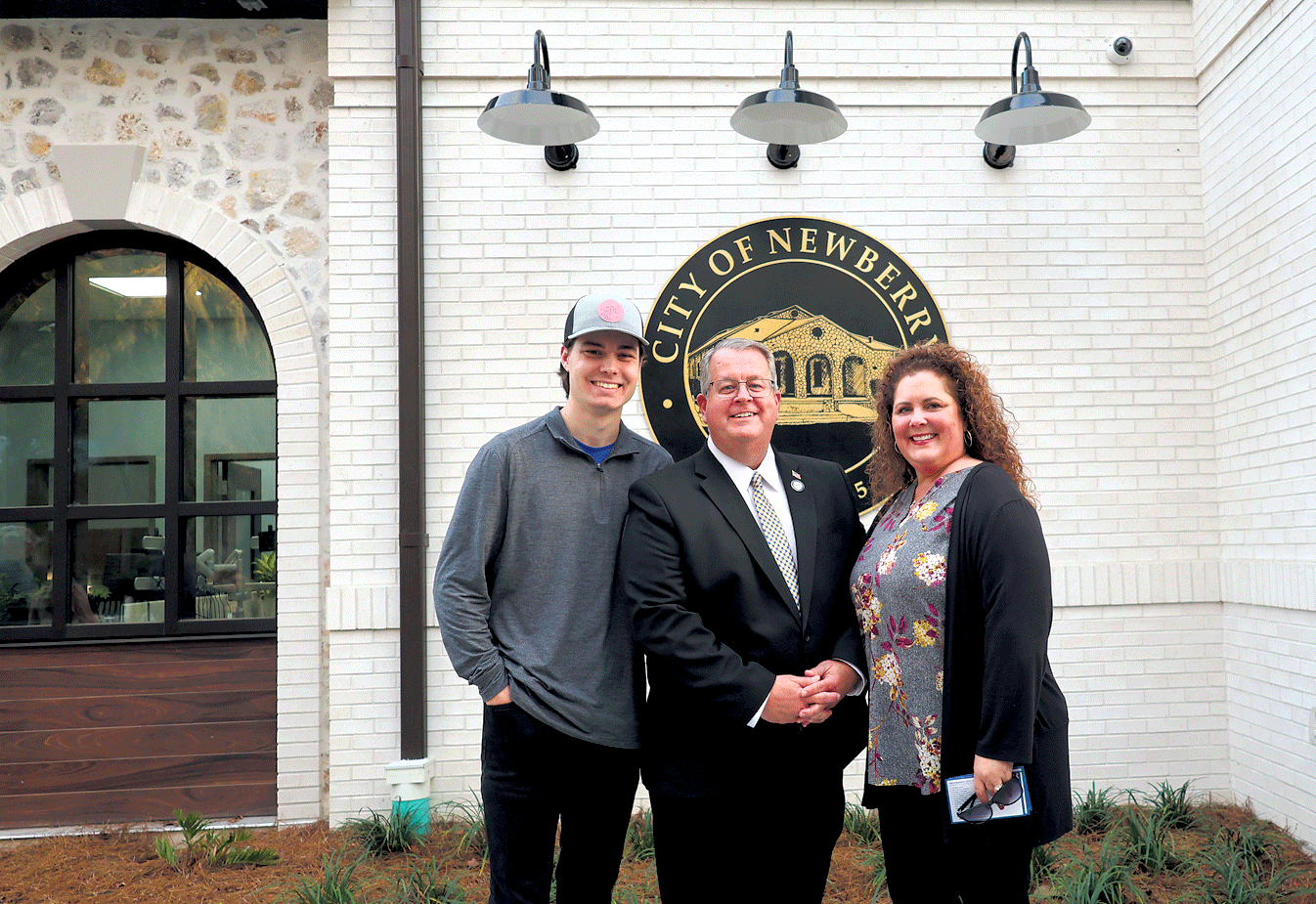
NEWBERRY – Newberry residents will soon get their first chance to step inside the city’s new City Hall. City officials announced an open house on Saturday, Nov. 15, 2025, during the Fall Festival, inviting the public to stop by between 10 a.m. and noon for a brief tour led by Mayor Tim Marden or City Manager Jordan Marlowe. The event will offer a sneak peek of the long-anticipated facility ahead of the official ribbon-cutting ceremony on Nov. 24.

Construction on the two-story, 11,000-square-foot City Hall is now in its final stage, signaling a major milestone in Newberry’s effort to bring key government services under one roof. The project broke ground in September 2024 and has progressed steadily over the past year.

For decades, residents have navigated multiple locations for city services — with Community Development and the Building Department operating out of the historic Little Red Schoolhouse, while other departments worked from Annex 2 across the street or the current City Hall building. The new consolidated facility aims to streamline services for residents, developers and business owners.

The first floor will house high-traffic, customer-facing operations including Finance, Community Development, Customer Service and the Building Department. The second level will feature 18 offices and three collaborative work areas for staff. While an elevator will serve both floors, most public services will remain on the ground level for convenience. The building does not include private offices for the mayor or commissioners, but meeting spaces will be available for private conversations when needed.

A centerpiece of the project is the 1,246-square-foot Commission Chamber, designed to accommodate more attendees during public meetings. An accordion wall will allow the space to expand for large gatherings or contract for smaller sessions. Additional conference rooms and updated technology will support modern service delivery and public engagement.

City planners say the building was designed to complement downtown surroundings while upgrading the functionality of city services. Officials describe the facility as a long-term investment supporting Newberry’s continued growth.

The project team includes Scorpio Construction of Gainesville and Monarch Design Group, with city staff actively involved throughout the construction process. When the new building opens, the existing 3,300-square-foot City Hall will undergo renovations and be linked to the new facility via a covered loggia. The connection will form a paved outdoor space intended for community events, farmers markets and festivals.

The adjacent Little Red Schoolhouse Museum is also slated for improvements in a later phase.

With completion approaching and public tours set to begin, residents will soon see firsthand how the new facility supports more centralized and efficient city operations.

#     #     #

email editor@

alachuatoday.com

NEWBERRY – A 56-year-old Newberry man has been arrested on seven felony charges related to child sexual abuse material following a year-long investigation that began with a cyber tip from the National Center for Missing and Exploited Children.

According to the Alachua County Sheriff’s Office, detectives arrested Matthew Cory Green on Oct. 30, 2025, after obtaining a second search warrant for his residence. The investigation originated from a July 2024 CyberTip that reported three videos uploaded via the messaging platform Kik. The videos reportedly depicted the sexual exploitation of pre-pubescent children and a video involving a child and an animal.

The CyberTip was formally assigned to a detective in November 2024. Sheriff’s officials noted that the delay in advancing the investigation was due to a backlog of digital sexual exploitation cases and other ongoing investigations. Active investigative work began in July 2025, when detectives submitted search warrants to internet service providers and reviewed subscriber records as they were returned.

Investigators traced IP addresses connected to the Kik account to a Verizon mobile account tied to Green’s Newberry residence. A search warrant was first issued Oct. 3, but deputies reported they were unable to execute it because Green was out of town and personnel were not available to return before the warrant expired.

To ensure Green would be home for a second warrant, a judge approved a phone location order on Oct. 23. Detectives monitored location data and confirmed Green traveled between his home and a workplace believed to be in Jacksonville. On Oct. 30, location information indicated he was at his residence, and deputies, assisted by Gainesville Police, executed the warrant.

After being advised of his rights, Green reportedly confirmed the phone number and email linked to the Kik account were his. According to the arrest report, he acknowledged having a pornography addiction and stated he had traded images and videos with others online. He reportedly said he had encountered child sexual abuse material, would view it if it appeared, and had previously searched for bestiality content. He denied actively seeking child sexual abuse material, though investigators said he stated he had “probably come across” the videos referenced in the CyberTip.

During the search, investigators seized digital devices. Forensic examinations are ongoing.

In a public statement, the Sheriff’s Office acknowledged the proximity of Green’s residence to Newberry Elementary School but stated that, “at this stage of the investigation, there is no evidence indicating that he had any physical contact or direct involvement with students in the area.” The agency emphasized the case remains active and additional charges may be filed.

Green is charged with three counts of possession of child sexual abuse material, three counts of digital transmission of such material and unlawful use of a two-way communication device. He had no prior criminal history in Alachua County. Judge Meshon Rawls set bail at $200,000.

#     #     #

Email cwalker@

alachuatoday.com

JACKSONVILLE, Fla. —Today, Governor Ron DeSantis and First Lady Casey DeSantis announced Florida awards $30 million in grant funding to four specialty children’s hospitals in Florida to develop and improve access to clinical trials, advance treatment protocols, and discover cures for childhood cancer. Johns Hopkins All Children’s Hospital in St. Petersburg, Nemour’s Children’s Hospital in Orlando, Nicklaus Children’s Hospital in Miami, and Wolfson Children’s Hospital in Jacksonville were each awarded $7.5 million.

“Since I became governor, Florida has invested more than $1 billion in cancer research and treatment—a 114% increase. We created the Cancer Connect Collaborative Research Incubator program within the Florida Department of Health this year to enhance cancer research throughout Florida,” said Governor Ron DeSantis. “Four of Florida’s top children’s hospitals have received a total of $30 million in funding for their innovative proposals to help children and adolescents who are fighting cancer. By investing in statewide infrastructure for pediatric cancer initiatives, we aim to eliminate the need for Florida families to travel out of state for potentially life-saving experimental therapies and specialized care.”

The Cancer Connect Collaborative Research Incubator was created in 2025 to further Florida efforts as a leader in cancer research and treatment. The Incubator is funded with $30 million and will focus on pediatric cancer in its first five-year funding cycle. While pediatric cancer accounts for just one percent of cases nationally, Florida’s pediatric cancer population is significant, with the state accounting for six percent of all new pediatric cancer cases in the U.S., thereby impacting thousands of children and families every year.

“Research Incubator investments to advance research, prevention, and treatment for pediatric cancer represents a meaningful step forward in our mission to improve outcomes, strengthen families, and ensure that every child has access to the most advanced care possible right here in Florida,” said First Lady Casey DeSantis. “I’m deeply grateful to Governor DeSantis for his unwavering leadership and commitment to advancing cancer research in Florida.”

“Thanks to the vision and leadership of First Lady Casey DeSantis, Florida continues to set the national standard for advancing adult and childhood cancer research and care,” said State Surgeon General Dr. Joseph A Ladapo. “Through the Cancer Connect Collaborative Research Incubator, we’re not only investing in science—we’re investing in hope for children and families across the state.”

The Incubator is part of Florida’s Cancer Connect Collaborative, an innovative model designed to accelerate research, share best practices, and turn data into actionable results. Guided by five pillars—Data, Best Practices, Innovation, Honesty, and Funding—the initiative brings together public and private partners to reshape cancer care delivery.

“Thanks to the leadership of First Lady and Governor DeSantis, Florida continues to make cancer research and treatment a top priority,” said Agency for Health Care Administration Secretary Shevaun Harris. “The Cancer Connect Collaborative Research Incubator is a bold step forward, beginning with pediatric cancer research. We look forward to seeing the strides made among the awardees and the collaboration that will accelerate breakthroughs, improve access to therapies, and offer hope to families across our state.”

#     #     #

email editor@

alachuatoday.com

~ 24 of 26 economic development awards will go to small and rural communities ~
TALLAHASSEE, Fla.—Today, FloridaCommerce announced the award of more than $1.5 million through the Community Planning Technical Assistance (CPTA) and Competitive Florida Partnership programs. The funding will support 26 Florida communities—including 24 small and rural communities—in developing and implementing plans to drive local economic growth.

“Under Governor DeSantis’ leadership, FloridaCommerce continues to support Floridians in building strong, resilient communities,” said Florida Secretary of Commerce J. Alex Kelly. “Since 2019, FloridaCommerce has awarded more than $7.6 million through the CPTA program to over 110 communities—empowering many of Florida’s small and rural communities to advance strategic economic initiatives and strengthen their local economies for future growth.”

The CPTA grant program seeks to strengthen communities through resilient, long-term economic development strategies and promotes innovative planning solutions to protect Florida's natural resources. Similarly, the Competitive Florida Partnership program supports communities in developing plans to attract new businesses and create workforce opportunities that promote partnerships, community design and a viable economy.

The following communities will receive funding through the CPTA grant program:

  • Bradford County ($75,000) – to create an Economic Development Strategy, outlining objectives, tactics, resources and marketing to promote county opportunities.
  • Opportunity Florida ($47,575) – to conduct an economic analysis study in the following rural counties: Calhoun, Franklin, Gadsden, Gulf, Holmes, Jackson, Liberty, Wakulla, North Walton and Washington.
  • Apalachee Regional Planning Council ($74,231.82) – to complete a multi-county Strategic Sites Inventory to prepare for industrial reshoring and business recruitment in Calhoun, Gadsden and Liberty Counties.
  • City of Crystal River ($75,000) – to develop a strategic and economic development plan for the city of Crystal River in Citrus County.
  • City of Keystone Heights ($60,000) – to review and update the comprehensive plan for the city of Keystone Heights in Clay County.
  • DeSoto County ($75,000) – to update the county plan to expand investment and tourism opportunities.
  • Central Florida Regional Planning Council ($75,000) – to create the Heartland Agricultural Land Use Conversion Study to enhance planning, coordination, and resilience in the following counties: DeSoto, Hardee, Highlands, Okeechobee and Polk.
  • Town of Cross City ($75,000) – to update land development regulations and zoning atlas for the town of Cross City in Dixie County.
  • Town of Horseshoe Beach ($75,000) – to implement Phase II of the Recovery and Resilience Plan, focusing on drainage, housing, and capital projects in Dixie County.
  • Gadsden County ($75,000) – to develop a Strategic Sites Inventory to identify and prepare sites for industrial and manufacturing growth.
  • Glades County ($55,000) – to update land development regulations and create fact sheets, checklists, and revised applications.
  • Hardee County ($60,000) – to create a Mass Casualty Incident and Reunification Plan to strengthen emergency medical response.
  • Town of Sneads ($45,000) – to support the development of a downtown revitalization and development plan for the Sneads "Old Downtown" area in Jackson County.
  • City of Clermont ($50,000) – to update the city plan to guide infrastructure, economic development and tourism strategies for the city of Clermont in Lake County.
  • City of Cedar Key ($75,000) – to advance shoreline and infrastructure protection strategies for the city of Cedar Key in Levy County.
  • Town of Greenville ($48,500) – to conduct a housing analysis and update economic and comprehensive plans for the town of Greenville in Madison County.
  • Village of Indiantown ($74,275) – to finalize the inaugural plan and add an economic development element for the village of Indiantown in Martin County.
  • City of Crestview ($50,000) – to develop a Strategic Economic and Development Plan to assess workforce, land-use assets, and branding, with clear goals and implementation steps for the city of Crestview in Okaloosa County.
  • Okeechobee County ($40,400) – to update the land development code.
  • Town of Loxahatchee Groves ($75,000) – to develop a comprehensive strategy for growth and resilience for the town of Loxahatchee in Palm Beach County.
  • Town of Kenneth City ($40,000) – to create an economic development strategy to strengthen commercial corridors and small businesses for the town of Kenneth City in Pinellas County.
  • City of Fort Meade ($45,000) – to update the Community Redevelopment Plan to assess progress and set future priorities for the city of Fort Meade in Polk County.
  • City of Palatka ($75,000) ­– to advance the Gateway Redevelopment Plan for the former Port Consolidated site, ensuring sustainable reuse for the city of Palatka in Putnam County.
  • Taylor County ($75,000) – to create an Economic Development Strategic Plan.
The following communities will receive funding through the Competitive Florida Partnership grant program:
  • Franklin County ($32,930) – to develop a comprehensive economic development strategy aimed to strengthen the local economy, reduce retail leakage and increase job creation in the commercial sector.
  • Hardee County ($32,930) – to develop a master plan for the county’s Government Center and Resiliency Hub, a facility that will provide support during emergencies, acting as a central point of contact for accessing services, building community, and preparing for and recovering from disruptions.

#     #     #

email editor@

alachuatoday.com

The following is a press release provided by the University of Florida. It has been published here as received, without additional reporting or editing by Alachua County Today staff. ~ 


Oct. 19, 2025 — “On behalf of the Board of Trustees and the University, we express our full support for Athletic Director Scott Stricklin and his decision to make a change in the leadership of our football program.

Today’s news underscores our collective, continuing, and uncompromising commitment to a Gators football program that inspires pride across the University community and competes annually for national championships.

We will continue to provide the athletic department with every resource necessary to deliver on that promise.”

The following is a press release provided by the University of Florida. It has been published here as received, without additional reporting or editing by Alachua County Today staff. ~

Statement from Athletic Director Scott Stricklin:

Today I met with Coach Napier and informed him that a change in leadership of our football program would best serve the interests of the University of Florida.

On behalf of Gator Nation, I want to sincerely thank Billy and his family for their tireless commitment to the Florida Gators. Billy built a tremendous culture of accountability and growth among the young men he led each day. His organized and detailed approach had a meaningful impact across all levels of our program.

As Coach Napier has often said, this is a results-driven business, and while his influence was positive, it ultimately did not translate into the level of success we expect on the field.

I have named Billy Gonzales as the interim head coach. Coach Gonzales has been a valued member of our program for many years, including being a part of multiple championship teams. He is a Gator through and through. His deep understanding of our culture, our student-athletes, and what it means to represent the University of Florida makes him well-suited to lead our team.

Making this decision during the open date provides our team valuable time to regroup, refocus, and prepare for the challenges ahead. The timing also allows us to conduct a thoughtful, thorough, and well-informed search for our next head coach. We remain fully committed to utilizing every resource available to identify the right leader to guide Gators Football into the future.

I will conduct the search with a high degree of confidentiality to protect the privacy of those involved. The search will focus on the hiring of an elite football coach who will embody the standard we have at the University of Florida, and we will continue to provide all of the necessary resources for that coach, his staff and the players to be successful.

Any time you conduct a head coaching search, especially for a high-profile sport like football or men's basketball, you learn something. The lessons from past experiences will guide us through the work ahead.

Across the University of Florida, there is an unwavering and uncompromising commitment to being the best in everything we do. This includes our athletic department, as evidenced by the fact UF is the only school in the country to win three national championships in both football and men's basketball.

The standards and expectations for Gators football are to win championships-not simply to compete. We exist to win, and will not settle for less.  UF has never been more invested in the success of this football program - elite facilities, robust NIL opportunities and comprehensive support for our student athletes and staff - than we are today.

The University of Florida is a destination - a place where people come to achieve excellence.  With our resources, passionate fan base, and unwavering commitment, we are determined to return Gators football to championship form.  I understand and accept the responsibility to deliver a football program that reflects the greatness of this university and I thank Gator Nation for their continued support as we begin this next chapter together.

Scott Burns
Director of Football Communications
University of Florida Athletic Association
C: (812) 322-5285
FloridaGators.com<http://www.floridagators.com/>

GAINESVILLE, Fla. – The Florida prosecutor’s office in Tampa is defending its controversial and unexpected decision to drop a felony criminal case against the man accused of tying his bull terrier dog to a fence in rising waters and abandoning it along Interstate 75 amid an evacuation ahead of a major hurricane.

The Hillsborough State Attorney’s Office, led by Suzy Lopez, said it lacked witnesses and sufficient evidence to win a conviction on a felony aggravated animal cruelty charge in a trial. The case involved “Trooper,” the dog renamed after the Florida Highway Patrol officer who rescued him.

“While this case stirs many emotions and even ethical questions, we do not have a good-faith basis to continue this prosecution,” the state attorney’s office said. 

The prosecutor’s office filed paperwork Wednesday to drop its case against Giovanny Aldama Garcia, 24, of Ruskin, Florida. Aldama Garcia had told an investigator he had been trying for months to get rid of the dog, which he had named Jumbo, and left the dog on the side of I-75 as he and his mother evacuated Florida’s west coast ahead of Hurricane Milton, court records said. 

The case made national news. Gov. Ron DeSantis called the dog’s treatment “unacceptable” and said the state would hold the dog’s owner accountable. Lopez, the state prosecutor, chimed in, too, and said she couldn’t fathom tying a pet to a fence in such conditions.

In a new one-page memorandum circulated Friday, Lopez’s office said that during trial preparations it became clear there weren’t witnesses or evidence to prove that Aldama Garcia had tied the dog to the fence in rising waters.

The memo said video from the highway patrol showed the dog’s collar was stuck on the fence, and a witness earlier had seen the dog loose near the interstate. It said Aldama Garcia and his mother said the dog was becoming stressed and aggressive during their drive and the dog jumped from the car when they stopped to deal with the situation.

“The facts as depicted in the video and the statements do not support the theory that the dog was attached to the fence in an intentional manner,” the memo said. It added: “A failure to locate the dog during an emergency evacuation does not equate to a criminal failure to act.” 

A legal expert on animal cruelty laws and co-creator of Florida’s Animal Cruelty Taskforce, Adam Stern, said prosecutors would have needed to prove that Aldama Garcia caused the dog either death or injury – which include physical trauma or neglect.

He said in some cases, aggravated animal cruelty charges can be hard to prove without tangible, physical evidence. No case is ever as straightforward as it seems, he said. 

“There's always going to be a monkey wrench that something comes up, that there's a new piece of evidence or there is a small piece that's missing,” he said. “In some cases, there's evidence to exonerate somebody because they didn't do it and it was somebody else, or it was an accident.”

Stern has been involved as a legal expert in thousands of animal cruelty cases, including ones where animals have been tethered to dog houses with rising flood waters then drowned.

By law, that would be aggravated animal cruelty, he said. The case in Tampa was different, according to the new prosecutor’s memo, which said there was no evidence that Trooper was deliberately tied to a fence.

The highway patrol video of the dog’s rescue went viral. The officer wrote in his arrest warrant that he was responding to a 911 call that a dog had been abandoned and tied to a post. The dog can be seen in water levels up to his chest, trembling and shaking. Investigators later interviewed Aldama Garcia after he showed up at an animal shelter to recover the dog.

“The defendant stated he observed the dog in standing water in heavy rain during a hurricane evacuation and left him behind,” the trooper wrote in the arrest report.

A press release from the prosecutor’s office in October 2024 announcing the criminal case against Aldama Garcia also had described the dog as “tied up.” 

Fresh Take Florida, a news service of the University of Florida College of Journalism and Communications, asked Friday under Florida’s public records law for a copy of the trooper’s body cam video and any recorded interview between investigators and Aldama Garcia. The prosecutor’s office said it would cost $686 to review and turn over.

Trooper’s new owner, Frank Spina of Parkland in South Florida, said Lopez called him to personally deliver the news of the dropped case earlier this week. He said she cited a language barrier between Aldama Garcia and investigating officers along with a lack of evidence as reasoning.

He was fuming. 

Spina said that just two months ago, the state attorney’s office considered this their most important case, only to drop it at a whim. 

“You’re going to have a tough time when you've got to talk to Ron [DeSantis] and Casey [DeSantis] and say you're ditching this case,” he said in an interview Thursday night. 

“In my opinion, this was a high-profile case that everybody was watching,” he said. “They were afraid to lose it on TV.”

___

GAINESVILLE, FL  — The excitement was palpable as University of Florida leadership, corporate partners and state officials gathered for the unveiling of the country’s fastest university-owned supercomputer Tuesday at the institution’s East Campus, officially launching the next generation of the groundbreaking HiPerGator system.

The event marks the latest milestone in the university’s artificial intelligence initiative, which began in 2020 and serves as a national model for harnessing AI to build America’s future workforce and boost the country’s national competitiveness. 

Elias G. Eldayrie, senior vice president and chief information officer, welcomed more than 125 guests to the ceremony, including representatives from UF’s Board of Trustees and cabinet, NVIDIA and U.S. Representative Kat Cammack. 

Student groups showcased how they use AI at the university, providing a living demonstration of the system’s power. Attendees saw AI in action, from the Swamp Launch Rocket Team’s aircrafts to the Gator Motor Sports vehicle to the award-winning UF Steel Bridge and the research of iGEM, the world’s premier synthetic biology competition. 

“As Florida’s flagship university, UF has embraced a bold and audacious vision: to be the nation’s AI university. Our commitment to AI is not just promoting economic growth across the state and giving our students the tools they need to be America’s next generation of leaders,” said UF Board of Trustees Chair Mori Hosseini. “It’s also protecting lives, preserving resources, feeding the world, improving health outcomes, and making Florida stronger, safer and better prepared for tomorrow.”

HiPerGator representatives gave tours of the updated machine, including a replacement of the NVIDIA DGX A100 “Ampere” SuperPOD from 2020 with a DGX B200 “Blackwell” SuperPOD, which measures 30 times faster than the previous HiPerGator generation. 

The $33 million purchase is a highly anticipated step in a long-standing engagement between NVIDIA and UF that has resulted in a comprehensive push to integrate AI education and research across every academic discipline at UF. 

A team of about a dozen experts installed the 63 NVIDIA DGX B200 nodes, with each 8 NVIDIA Blackwell graphics processing units (GPUs), for a total of 504 GPUs.

HiPerGator recently ranked No. 3 in the world for speed (how quickly it responds to an AI question) and No. 4 for efficiency (how many AI questions it can handle at once), according to the standard MLCommons benchmark. 

“Every part of this university is a playground for AI,” said UF Interim President Donald W. Landry. “This land-grant institution has succeeded in what we want to see across the state… The combination of vision, partnership and dedication leads us to this moment.”

UF’s extraordinary computing infrastructure has played a key role in the university’s reputation, faculty recruitment and retention, and fast-rising research prowess. This upgrade of UF’s supercomputer continues the evolution from HiPerGator 1.0 (2013-2021) to HiPerGator 2.0 (2015) to HiPerGator 3.0 and HiPerGator AI (2021), each version faster and more powerful than the last.

More than 60% of UF’s $1.33 billion annual budget for research goes toward projects that rely on HiPerGator.

With more than 100 new AI faculty and 230 AI and data science courses, HiPerGator’s exceptional computational capabilities support a wide range of teaching and research advances in areas from engineering and medicine to history and astronomy. In the past year, the system supported nearly 7,000 users from across the Southeast. One service enabled by HiPerGator is NaviGator AI, which offers UF faculty, students and staff access to more than 40 large language models to experiment with generative AI. 

“What this group of folks and leadership has done represents a model that is going to transform the nation,” UF alumnus and NVIDIA cofounder Chris Malachowsky, a key partner and donor in UF’s sweeping initiative to lead the country in creating the next AI workforce. 

“This is a testament to the machine to be exploited and taken advantage of,” Malachowsky added. “Take it and run. It’s bold and powerful and impactful.”

#     #     #

email editor@

alachuatoday.com

William Garst HSEveryone taking prescription medications should be aware of essential safety practices. Here are six tips to help ensure you are taking your medicine correctly and safely:

1. Maintain a Comprehensive Medication List

Keep an up-to-date list of everything you take, and share it with every healthcare provider you see (doctors, specialists, dentists, and pharmacists).

  • Include: All prescription drugs, over-the-counter (OTC) medications, vitamins, herbs, and dietary supplements.
  • Detail: The name, dosage, how often you take it, and the reason it was prescribed.
  • Why it matters: This is the most crucial step to prevent dangerous drug-to-drug interactions, to ensure you don't accidentally overdose on two products with the same active ingredient, and to help your doctor avoid prescribing medicine you shouldn't take.

2. Know the "Five W's" of Each New Drug

Before you leave the doctor's office or the pharmacy, make sure you know the following for every new prescription:

  • What is the name of the drug and what is it for?
  • When should I take it (e.g., morning, night, with food, on an empty stomach)?
  • What are the most common side effects, and when should I call the doctor?
  • What foods, drinks (like alcohol or grapefruit juice), or other medications should I avoid?
  • Why am I taking this (What is the goal of the therapy)?

3. Take Your Medication Exactly as Prescribed

Consistency is key to the drug's effectiveness and your safety.

  • Follow Directions: Take the exact dose at the exact time(s) specified. Do not skip doses, and never take a larger dose because you think it will work faster.
  • Do Not Stop Early: Finish the full course of a prescription (especially antibiotics), even if you start to feel better. Never stop taking a maintenance drug on your own; always consult your doctor first.
  • Ask Before Modifying: Do not crush, cut, or chew tablets unless your pharmacist or doctor specifically says it is safe, as this can affect how the drug is absorbed or release the medicine too quickly.

4. Use a Single Pharmacy

Whenever possible, fill all your prescriptions at the same pharmacy.

  • Interaction Check: This allows your pharmacist—who is a medication expert—to have a complete and centralized record of your profile and automatically check for potential drug interactions or dosage conflicts.
  • Ask Questions: Your pharmacist is your best resource for practical advice on when and how to take a medication and what common side effects to expect.

5. Store and Dispose of Medication Safely

Improper storage can ruin the drug's effectiveness, and improper disposal can lead to danger.

  • Storage: Keep most medications in a cool, dry place, away from heat and direct sunlight. The bathroom medicine cabinet is often too humid for proper storage.
  • Security: Always store medications, especially controlled substances and pain relievers, in a secure place out of reach and out of sight of children, pets, and visitors.
  • Disposal: Never flush medicine down the toilet or throw it in the trash unless the label specifically instructs you to. Find a drug take-back program or a community disposal site (often at local police departments or pharmacies) for safe disposal of unused or expired drugs.

6. Never Share or Borrow Prescription Medication

Medications are prescribed based on an individual's specific medical condition, weight, allergies, and other concurrent medications.

  • For You Only: Never take medicine prescribed to another person, even if you have the same symptoms. What is helpful for one person could be dangerous or deadly for another.
  • Do Not Share: Never give your prescription to a family member or friend. If you have unused medication, dispose of it safely.

Prosper and be in health.

*     *     *

William Garst is a consultant pharmacist who lives in Alachua, Florida. He is semi-retired and works part time at Lake Butler Hospital in Lake Butler, Florida. William received his pharmacy degree at Auburn University and a Doctor of Pharmacy from Colorado University. The Pharmacy Newsletter is a blog where you can find other informative columns. He may be contacted at This email address is being protected from spambots. You need JavaScript enabled to view it..

#     #     #

Email editor@

alachuatoday.com

Sept 15 – Oct. 15 is the nationwide celebration of Hispanic Heritage Month. This year’s theme is “Collective Heritage: Honoring the Past, Inspiring the Future,” reminding us that our nation’s strength comes from the diverse people who call it home and the shared commitment to build a better future together.

From the arts and education to business and public service, Hispanic Floridians continue to enrich every aspect of life in our state. Their leadership, creativity, and dedication exemplify the power of community and the enduring belief that opportunity should be within reach for all.

The Florida Commission on Human Relations’ (FCHR) mission is to promote equal opportunity and prevent discrimination by investigating allegations of discrimination in housing, public accommodations, employment, and state whistleblower retaliation as well as educating Floridians about their rights and opportunities. Through our diligent work, we continue to build a Florida where everyone is treated with dignity and respect. For more information or to file a complaint, contact the Florida Commission on Human Relations at (850) 488-7082 or visit www.FCHR.MyFlorida.com.

This month, and throughout the year, we honor the past while inspiring the future, by recognizing the collective heritage that connects us, celebrating the diversity that strengthens us, and reaffirming our commitment to fairness for every Floridian.

Cheyanne Costilla, Executive Director

Florida Commission on Human Relations

The history of vitamin K is a story of a single discovery that later expanded to include a family of related compounds, each with distinct roles in the body. The journey from initial observation to a detailed understanding of vitamin K1 and William Garst HSK2 spans several decades and involves multiple scientists.

The Initial Discovery of Vitamin K

The story begins in the late 1920s with Danish biochemist Henrik Dam.

  • 1929: Dam was conducting experiments on chickens, feeding them a diet that was deficient in cholesterol and fat. After a few weeks, he noticed that the chickens developed a mysterious bleeding disorder, where their blood was slow to clot.
  • 1935: Dam concluded that a new, fat-soluble vitamin was missing from the chickens' diet. He named this substance “Koagulations-Vitamin,” which is German and Danish for “coagulation vitamin.” This is where the letter “K” comes from.
  • 1939: American biochemist Edward Doisy and his team at St. Louis University isolated and determined the chemical structure of the primary plant-based form of the vitamin, which they named phylloquinone. This substance would later be officially named Vitamin K1.

For their work on the discovery and chemical nature of vitamin K, Dam and Doisy were jointly awarded the Nobel Prize in Physiology or Medicine in 1943.

Vitamin K1 (Phylloquinone)

  • Source: From the very beginning, it was clear that the "anti-hemorrhagic" factor came from plant sources, particularly green, leafy vegetables like spinach and kale.
  • Function: Early research, and the Nobel Prize, focused on its essential role in blood coagulation. Vitamin K1 acts as a crucial cofactor for an enzyme that "activates" several clotting factors in the liver, including prothrombin (Factor II), Factor VII, Factor IX, and Factor X. Without this activation, these proteins cannot function properly, leading to uncontrolled bleeding.
  • Modern Understanding: Vitamin K1's role in blood clotting remains its most well-known and clinically important function. It is used medically to treat bleeding disorders, and is routinely given to newborns to prevent a condition called Vitamin K Deficiency Bleeding (VKDB).

Vitamin K2 (Menaquinones)

The story of vitamin K2 is more recent and has led to a re-evaluation of the entire vitamin K family.

  • Discovery of a Second Form: Soon after the discovery of vitamin K1, scientists realized that there was another form of vitamin K. This second form, found in animal products and produced by bacteria, was chemically different. It was named menaquinone and collectively referred to as Vitamin K2. Unlike K1, which has a single chemical structure, K2 is a family of related compounds, designated as MK-4, MK-7, MK-9, etc., based on the length of their side chain.
  • Japanese Fermented Foods: A major breakthrough in the understanding of K2 came from research into the traditional Japanese food natto, a dish of fermented soybeans. Scientists discovered that natto was an incredibly rich source of a long-chain menaquinone, specifically MK-7. This led to a boom in research on K2's health benefits.
  • Beyond Blood Clotting: While K1 is primarily used by the liver for blood coagulation, researchers found that K2 has a different fate in the body. It is preferentially used by other tissues, especially bone and arterial tissues.
  • The “Calcium Paradox”: A key aspect of modern K2 research is its role in “calcium trafficking.” Scientists have discovered that K2 activates proteins like osteocalcin in bones, which helps bind calcium and integrate it into the bone matrix. At the same time, K2 activates Matrix Gla Protein (MGP), a protein that prevents calcium from building up in soft tissues like arteries. This led to the theory that K2 may play a significant role in both bone health (preventing osteoporosis) and cardiovascular health (preventing arterial calcification).

Summary of Key Differences and Modern Research

Feature

Vitamin K1 (Phylloquinone)

Vitamin K2 (Menaquinones)

Primary Source

Green leafy vegetables

Fermented foods (natto, cheese), animal products (egg yolks, some meats), and gut bacteria

Primary Function

Blood coagulation (clotting)

Bone health, cardiovascular health (preventing arterial calcification)

Historical Focus

The first form of the vitamin discovered; initial research focused entirely on this form for its anti-hemorrhagic effects.

A later discovery, with its distinct functions only becoming widely known and studied in the last few decades.

Chemical Structure

A single compound (phylloquinone)

A family of compounds (menaquinones), denoted as MK-4, MK-7, etc.

The history of vitamin K is a testament to how scientific understanding evolves. What began as a single discovery of a “coagulation vitamin” has expanded to encompass a complex family of nutrients with far-reaching effects on human health.

Prosper and be in health.

*     *     *

William Garst is a consultant pharmacist who lives in Alachua, Florida. He is semi-retired and works part time at Lake Butler Hospital in Lake Butler, Florida. William received his pharmacy degree at Auburn University and a Doctor of Pharmacy from Colorado University. The Pharmacy Newsletter is a blog where you can find other informative columns. He may be contacted at This email address is being protected from spambots. You need JavaScript enabled to view it..

#     #     #

Email editor@

alachuatoday.com

~ The First Recorded Clinical Trial in 1747 ~

The history of Vitamin C is closely linked to the understanding and eventual conquest of scurvy, a debilitating and often fatal disease that William Garst HSplagued sailors on long voyages for centuries.

Early Observations

As early as the 15th century, it was noted that certain foods, particularly citrus fruits, had a curative effect on scurvy. Vasco da Gama's voyages, for instance, observed this link.

In 1747, James Lind, a British naval surgeon, conducted a controlled experiment demonstrating that citrus fruits effectively prevented scurvy. He compared various treatments among sailors with scurvy and found that only those receiving oranges and lemons recovered. This is perhaps, the first recorded clinical trial.

Despite Lind's groundbreaking work, it took several decades for the British Navy to mandate citrus fruit or juice as a regular provision for sailors, earning them the nickname “limeys.”

The Dawn of Vitamin Research:

In 1912, Casimir Funk introduced the concept of “vitamins” as essential dietary components. The anti-scorbutic factor was soon recognized as a water-soluble substance, initially called “water-soluble C.”

Isolation and Identification:

In 1928, Hungarian scientist Albert Szent-Györgyi isolated a substance from animal adrenal glands, naming it “hexuronic acid.” He suspected it might be the anti-scorbutic factor.

Around the same time, in 1932, American biochemist Charles Glen King also isolated vitamin C in his laboratory and concluded it was the same as Szent-Györgyi's hexuronic acid. There was some dispute over who made the definitive connection first, possibly due to communication delays.

Working independently, Szent-Györgyi and his colleague Joseph Svirbely conducted experiments on guinea pigs (which, like humans, cannot synthesize vitamin C) and proved that hexuronic acid was indeed the anti-scorbutic factor. They renamed it “ascorbic acid,” meaning “anti-scurvy.”

Structural Determination and Synthesis:

In 1933, British chemist Norman Haworth determined the chemical structure of vitamin C. Haworth and Szent-Györgyi jointly proposed the name “ascorbic acid”

Both Szent-Györgyi and Haworth were awarded Nobel Prizes in 1937 for their work on vitamin C. Szent-Györgyi received the Nobel Prize in Physiology or Medicine for his discoveries concerning biological combustion, with specific reference to vitamin C, and Haworth received the Nobel Prize in Chemistry for his work on the constitution of carbohydrates and vitamin C.

Further Discoveries and Applications:

Szent-Györgyi continued his research, famously identifying paprika as an exceptionally rich and easily accessible source of vitamin C, allowing for its production in larger quantities.

Since its discovery, vitamin C has been extensively studied for its various roles in human health, including its function as an antioxidant, its involvement in collagen synthesis, immune function, and iron absorption.

Today, vitamin C is recognized as an essential nutrient, and its deficiency is known to cause scurvy, characterized by symptoms like weakness, bleeding gums, and poor wound healing.

Research continues to explore the potential benefits of vitamin C in preventing and treating various diseases.

The history of vitamin C is a compelling story of scientific investigation driven by the need to combat a devastating disease. From empirical observations to isolation, structural determination, and synthesis, the journey to understanding and utilizing this essential nutrient has significantly impacted human health

*     *     *

William Garst is a consultant pharmacist who lives in Alachua, Florida. He is semi-retired and works part time at Lake Butler Hospital in Lake Butler, Florida. William received his pharmacy degree at Auburn University and a Doctor of Pharmacy from Colorado University. The Pharmacy Newsletter is a blog where you can find other informative columns. He may be contacted at This email address is being protected from spambots. You need JavaScript enabled to view it..

#     #     #

Email editor@

alachuatoday.com

As a concerned citizen of Florida, I am writing to express my deep alarm over the recent decision to eliminate all vaccine mandates in our state. Vaccines have long been one of the most effective and life-saving public health tools we have. Rolling back these protections threatens to reverse decades of progress against diseases like measles, mumps, and polio — illnesses that vaccines had nearly eliminated.

This decision will not affect all Floridians equally. Black and Brown communities, already facing disproportionate rates of chronic illness, limited access to care, and systemic health inequities, will bear the heaviest burden. Without the safeguard of mandates, these communities are at greater risk of disease outbreaks and preventable deaths.

I am also concerned about the issue of trust. Our nation’s history of medical neglect and mistreatment of Black and Brown populations has left a deep scar of mistrust in the healthcare system. Abrupt policy changes such as this risk eroding fragile progress in building confidence and could reinforce skepticism toward public health guidance.

Beyond the health risks, there are serious financial and economic consequences. Preventable outbreaks lead to increased healthcare costs, hospitalizations, and strain on already overburdened medical systems. Families who cannot afford time off work or unexpected medical bills will be disproportionately harmed. Local businesses and schools may also face disruptions if vaccine-preventable diseases reemerge, causing lost productivity and economic instability. In short, what may appear to be a rollback of regulation could instead create higher costs for families, communities, and the state as a whole.

While individuals should have the right to make informed decisions — including the ability to opt out under certain circumstances — public health policy must balance personal choice with the protection of children, immunocompromised individuals, and entire communities. Without mandates or robust equity-driven alternatives, our most vulnerable neighbors will be left unprotected.

Faith and cultural values are also central to many families’ health decisions. Public health efforts should engage and respect these perspectives. But removing mandates outright, without strong outreach, education, and access initiatives, will send us backward — leaving communities exposed to diseases that science has already taught us how to prevent.

I urge you to reconsider this decision. If mandates are to be removed, Florida must implement strong, equity-focused measures to ensure that every Floridian — regardless of race, income, or faith — is protected. Public health policy must be guided not only by science and fairness but also by a recognition of the enormous economic and financial strain that preventable outbreaks place on families and our state.

Roberta C. Lopez

Archer, Florida

The history of the B vitamins is a fascinating journey that spans several decades and involves the work of numerous scientists. Initially William Garst HSthought to be a single nutrient, it was later discovered to be a complex group of essential water-soluble vitamins with distinct functions. Here's a brief overview of their discovery:

The Beriberi Connection

The story begins in the late 19th Century with the investigation of beriberi, a debilitating disease prevalent in regions where polished white rice was a dietary staple.

  • 1889: Dutch physician Christiaan Eijkman, working in the Dutch East Indies (now Indonesia), observed that chickens fed polished white rice developed beriberi-like symptoms, which were reversed when they were fed unpolished brown rice. This suggested a nutritional deficiency.
  • 1906: English biochemist Frederick Gowland Hopkins proposed the existence of "accessory food factors" beyond fats, proteins, and carbohydrates that were essential for growth and health.

The “Vitamine” Concept

  • 1911: Polish biochemist Casimir Funk, working in London, isolated a substance from rice polishings that could cure beriberi in pigeons. He proposed that this and other similar substances were vital amines, coining the term “vitamine.” Although not all vitamins are amines, the name stuck (later dropping the “e”).

Distinguishing Multiple Factors

  • 1913: American biochemist Elmer McCollum distinguished between “fat-soluble factor A” and “water-soluble factor B,” recognizing that there was more than one essential nutrient in the water-soluble category.

Isolation and Identification of Individual B Vitamins:

The subsequent decades saw the isolation and characterization of the individual B vitamins:

  • Vitamin B1 (Thiamin): Isolated in crystalline form in 1926 by Dutch chemists Barend Jansen and Willem Donath. It was the first B vitamin to be identified and was found to be the anti-beriberi factor.
  • Vitamin B2 (Riboflavin): First observed as a yellow-green fluorescent pigment in milk in 1872, it was characterized and named riboflavin in the early 1930s.
  • Vitamin B3 (Niacin): Its deficiency was linked to pellagra in 1915 by Joseph Goldberger. The chemical structure was determined in 1937 by Conrad Elvehjem.
  • Vitamin B5 (Pantothenic Acid): Discovered in 1933 by Roger J. Williams while researching essential nutrients for yeast.
  • Vitamin B6 (Pyridoxine): Identified in 1934 by Paul Gyorgy.
  • Vitamin B7 (Biotin): Research spanned the early 1900s, with contributions from Margaret Averil Boas (1927) and Paul Gyorgy (who named it Vitamin H in 1939), among others.
  • Vitamin B9 (Folate/Folic Acid): Identified in 1933 by Lucy Wills for its role in preventing a type of anemia during pregnancy.
  • Vitamin B12 (Cobalamin): Its deficiency was linked to pernicious anemia. It was isolated in 1947 by Karl Folkers and his team.

The “B Complex”

As each water-soluble vitamin with a distinct function was discovered, they were grouped together as the “vitamin B complex.” This term reflects their shared water solubility and their common occurrence in many of the same foods, as well as their often-interconnected roles in metabolic processes.

Nobel Prizes

The importance of B vitamin research is highlighted by the Nobel Prizes awarded to scientists involved in their discovery and understanding:

  • 1929: Christiaan Eijkman and Sir Frederick Gowland Hopkins were jointly awarded the Nobel Prize in Physiology or Medicine for their work on the discovery of vitamins. Eijkman's work focused on the link between diet and beriberi (leading to the identification of Vitamin B1), while Hopkins was recognized for his broader contributions to the understanding of essential nutrients.
  • 1934: George Whipple, George Minot, and William Murphy received the Nobel Prize for their work on the treatment of pernicious anemia using liver extracts, which eventually led to the isolation of Vitamin B12.
  • 1964: Dorothy Hodgkin was awarded the Nobel Prize in Chemistry for her work on determining the structures of important biochemical substances, including Vitamin B12.

Modern Understanding

Today, we have a detailed understanding of the chemical structures, functions, dietary sources, and deficiency symptoms of each of the B vitamins. They are known to play crucial roles as coenzymes in numerous metabolic pathways, affecting energy production, nerve function, red blood cell formation, DNA synthesis, and many other vital processes.

It's worth noting that several other substances were once considered part of the B complex and assigned B numbers (like B4, B8, B10, B11), but these were later found to be either synthesized by the body or not essential and were thus removed from the official list of B vitamins

*     *     *

William Garst is a consultant pharmacist who lives in Alachua, Florida. He is semi-retired and works part time at Lake Butler Hospital in Lake Butler, Florida. William received his pharmacy degree at Auburn University and a Doctor of Pharmacy from Colorado University. The Pharmacy Newsletter is a blog where you can find other informative columns. He may be contacted at This email address is being protected from spambots. You need JavaScript enabled to view it..

#     #     #

Email editor@

alachuatoday.com

FloridaPublicNoticesSite

FlaPublicNotices

Search Florida Public Notices


National News

State
Typography

GAINESVILLE, FL - New evidence emerged Friday raising more questions about the legal residency of a Republican who won election this week to the state House in South Florida as his Democratic rival filed an official complaint with the Florida Ethics Commission.

A letter dated June 19 the Florida Division of Elections mailed to an apartment complex where Rep. Michael David Redondo said he had leased a unit in House District 118 in June was returned July 5 by the U.S. Postal Service and marked "Return to Sender. Attempted - Not known. Unable to forward."

A political newcomer who runs his own law firm, Redondo, 38, of Miami, won Tuesday with 52% of the vote in the low-turnout special election, beating Democrat Johnny Gonzalo Farias, 54, of Miami, who received 46% of votes. A non-affiliated candidate received just under 3% of votes. Redondo's winning margin was 541 votes.

Earlier reporting showed Redondo bought a two-bedroom luxury, waterfront condominium for $950,000 that is 20 miles away in House District 113, according to property records. He signed a 30-year mortgage May 30 for $727,000 that required him to live in the condo as his principal residence for at least one year, records showed.

Under Florida law and the Legislature’s own rules, lawmakers take office immediately upon election and must live in the district "at the time of election." Lawmakers are allowed to own multiple homes but can only have one principal, or legal, residence.

Farias on Friday urged the Republican-led House, the Florida Bar and the State Attorney's Office to investigate what he described as fraud in the election. "Every voter is entitled to cast their vote on the truth and facts of each individual candidate," Farias said.

A statement Friday from his campaign noted that Rendondo's actions are overseen by the Florida Bar, which regulates the conduct of attorneys. 

"To have someone whose entire profession relies on his ethics, morals, and truthfulness lie to not only the public but his voters shows a lack of character," the campaign statement said.

Redondo has stopped responding since late Tuesday to a reporter's repeated phone messages and texts asking about his residency issues.

Meanwhile, the deputy campaign manager for Farias said she was filing a complaint with the Florida Commission on Ethics accusing Redondo of misleading voters. She listed Redondo’s address on the complaint to the ethics commission as his condo in House District 113.

"It is clear that he does not reside in District 118 and has signed a merely ceremonial lease in order to qualify to serve if elected," according to the complaint from Vanessa Brito, 40, of Miami. She said Redondo was legally bound to live in the waterfront condo outside his district, which would disqualify him as a lawmaker. Farias paid her $6,742 for her work on the election, according to campaign finance records. 

The latest disclosure involves the letter from state election officials to Redondo that was returned to sender. 

The Division of Elections mailed the June 19 letter, which acknowledged Redondo had appointed a new campaign treasurer, to the address Redondo had specified in correspondence with election officials June 15. The address Redondo gave at the time was the leasing office of the apartment complex behind a shopping center where Redondo said he had rented a unit, not the address of the building where his apartment was. Those buildings are less than 100 feet apart, and the address numbers are a single digit different.

When he gave the address of the leasing office to state officials, Redondo included his apartment number, but there are other buildings in the same complex with units that share the same apartment number. That may explain why the postal carrier couldn't deliver the letter.

Candidates were competing for the House seat vacated when Gov. Ron DeSantis appointed the incumbent, a Republican, to become the county court clerk. Then-Rep. Juan Fernandez-Barquin, 40, of Miami, resigned June 16.

Redondo updated his voter's registration with the correct apartment address on June 22 and used that address in subsequent correspondence in August with the elections division.

Still, address confusion persisted: Redondo’s tax preparer submitted to the IRS his 2022 return on Aug. 7 – nearly two months after Redondo said he moved into the apartment in District 118 – and listed Redondo's home address as the same building in District 113 where Redondo had purchased the luxury condo in May, records showed.

Redondo said he had been renting a different condo in the same building on the 34th floor since September 2020. He said he moved in June to the apartment on Southwest 122nd Avenue near the Kendallgate Shopping Center, which includes a pet store, a cosmetics store, a sneaker outlet and a crafts store.

House District 118 is a narrow strip of suburban neighborhoods west of Miami that extends north from Homestead to Southwest 8th Street.

The Florida Commission on Ethics is made up of nine members, five appointed by the governor, two by the Senate president and two by the House speaker. The commission currently consists of five Republicans, three Democrats and one non-party affiliated commissioner. 

The commission’s chair, Republican Ashley Lukis, who was appointed by Gov. Ron DeSantis, is the wife of DeSantis’ former chief of staff, Adrian Lukis.

The commission only has the power to recommend penalties for potential ethical violations and cannot enforce any of its recommendations. If it were to find that Redondo violated Florida ethics law, it can recommend penalties to the House. 

Including Redondo, Republicans hold 84 seats in the House. Democrats hold 35 seats.

The residency clause in the condo mortgage Redondo signed required that he live in the 21st-floor, corner unit – with two balconies with views of Biscayne Bay and downtown Miami, a private elevator, floor-to-ceiling windows and stainless steel kitchen – starting no later than July 2023, or within 60 days after he signed the mortgage. His leased apartment across town has a view of a parking lot and the back of the shopping mall.

The provisions in the mortgage from Miami-based City National Bank of Florida mean that Redondo was either violating the banking contract he signed by living in the leased apartment since June – or if he was living in the luxury condo, he would not have been a resident of the district where he was elected Tuesday night.

A spokesman for the bank, Aaron Gordon, said the bank does not discuss its clients as a matter of policy and privacy. 

Asked this week whether he was violating the mortgage clause by living in an apartment across town, he said, "Not that I'm aware of." The mortgage is a publicly accessible document filed with the county clerk of court – a government office that in this case is overseen by the former incumbent Republican lawmaker in District 118 who Redondo is replacing.

The mortgage provision permits Redondo to live elsewhere but only with written approval in advance from the bank. Redondo said he did not know whether he obtained that permission, in writing or otherwise. Such residency clauses are usually imposed by lenders offering a lower interest rate on a mortgage for a person's primary residence than would be available for an investment property.

The issues with Redondo’s addresses were discovered during routine election reporting on the race and its candidates by Fresh Take Florida, a news service of the University of Florida College of Journalism and Communications. 

#     #     #

Email editor@

alachuatoday.com.